
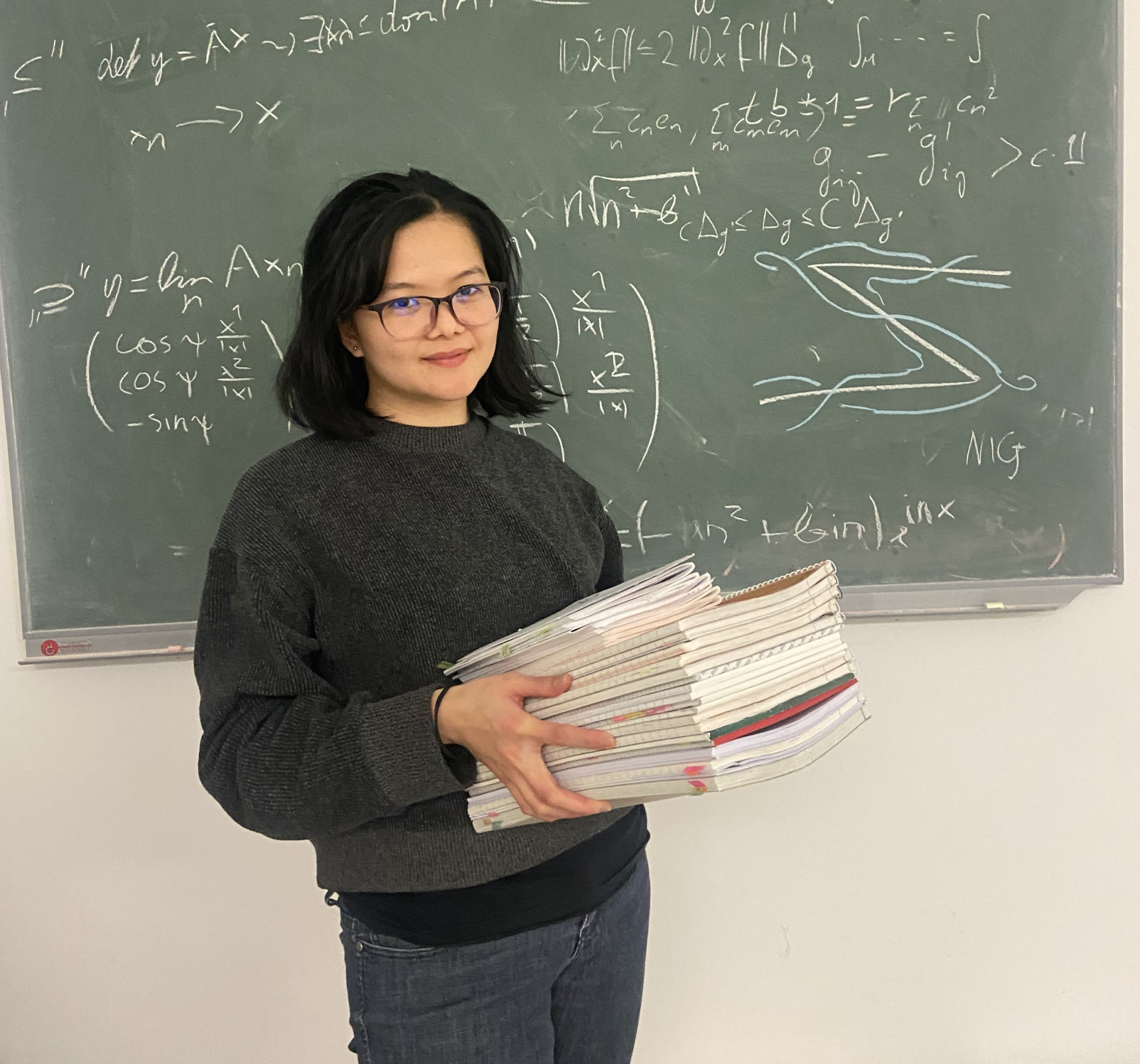
Born in Cabanatuan City, Philippines • Birth year 1993 • Studied Mathematics at the University of the Philippines Baguio in Philippines • Dr. rer. nat. in Mathematics from University of Vienna in Austria • Lives in Quezon City, Philippines • Assistant Professor at the Institute of Mathematics, University of the Philippines Diliman
The very first memory I have of learning mathematics was set one afternoon in our home in the Philippines. I was about five years old, and my dad, hoping to sneak in a nap, decided to turn me into a human alarm clock. He patiently taught me how to read an analog clock, the short hand for the hour and the long hand for the minutes. Counting by fives as the minute hand ticked away, waiting to wake him up, was the first time I became fascinated with numbers and logic. Things just made sense.
Growing up, I always enjoyed math, but I had no idea you could get a university degree in it. When it came time for university admission, people around me suggested engineering for financial security. I ended up choosing a BS in Mathematics purely because of a rumor that it was a strategic backdoor into a highly competitive engineering program.
I never made that shift.
What kept me were the “Eureka” moments, those instances where a concept you’ve wrestled with finally clicks into place, and the realization that I wanted to teach. I had been deeply inspired by my female homeroom and Sunday school teachers, and I wanted to be the one at the front of the room, confidently sharing knowledge.
Realizing that my life didn’t need to be a classical solution was cathartic.
My academic journey eventually took me far beyond the Philippines. My first plane ride was for a national conference, followed by a school abroad, and eventually a leap to Europe for my doctorate. The world felt suddenly accessible, and simultaneously daunting.
In my research, I work with differential equations, mathematical tools used to model how systems change and evolve over time. When we try to solve these equations, our first instinct is to look for a “classical solution,” a path that is well-behaved and continuously differentiable at every point. But such a solution only exists if your starting conditions are strong enough to support it. When I first moved to Vienna, my own starting conditions felt completely upended. I remember bawling my eyes out. A series of unfortunate events, coupled with the isolation of the 2020 pandemic, shattered any hope for an orderly transition. The hardest moment came near the end of my doctorate, when I had to extend my stay beyond my scholarship, suddenly self-financing, floating, and convinced I didn’t belong in academia. I had started looking for ways out altogether.
But in mathematics, when a classical solution doesn’t exist, we don’t give up on the system. We look for alternatives, “mild” or “weak” solutions, that relax the requirement of differentiability. A mild solution replaces it with integrability; a weak solution goes further, working with generalized derivatives instead. The path no longer needs to be perfectly well-behaved at every point. It just needs to hold together in a broader sense. Realizing that my life didn’t need to be a classical solution was cathartic. What carried me through was realizing I didn’t have to hold everything together alone. I had people in different parts of my life, in different corners of the world, and that was enough to get me to the other side. Eventually, I applied for a position back home, and slowly, things began to fall into place again.
(…) Mathematics is vast, a language, a science, and an art. More people should know this.
By graduate school, the demographics of mathematics had shifted from what I knew growing up. When I was younger, there were just as many girls excelling in math as boys, maybe more. But the ratio had flipped, and it was easy to feel the loneliness of that. It became even clearer when I taught a graduate course and realized the entire class was male. I hadn’t fully noticed the shift until I was standing at the front of it. One day, I hope seeing women in graduate mathematics classes is the norm, not the exception. A recent all-women and underrepresented-genders workshop reminded me that this future is possible. The energy was joyful, with a wonderfully flat hierarchy where nobody was trying to outshine anyone else.
My hope for the Philippines is more visibility of what mathematics actually is. Once, in a taxi, the driver asked what I studied. I said mathematics, and he genuinely wanted to know what that meant, what I actually do, what I would become. I wish more people were like him. People often assume it means being a human calculator. But mathematics is vast, a language, a science, and an art. More people should know this.
If I could give advice to my younger self, and to any early-career woman reading this: don’t take yourself too seriously, and don’t be afraid to make mistakes. Ask questions, and don’t be ashamed to say you don’t know something. Learning starts with curiosity, and if a manong driver can ask without hesitation, so can you.
Published on September 16, 2026.
Photo credit: Gervy Marie Angeles