MathematicalPhysics

Mikaela Iacobelli

Mikaela Iacobelli

Born in Giulianova, Italy • Birth year 1987 • Studied Mathematics at Sapienza University of Rome, Italy • PhD in Mathematics from Sapienza University of Rome and École Polytechnique in Paris • Lives in Zürich, Switzerland • Associate Professor of Mathematics at ETH Zürich

I was born in a small town on the Adriatic coast, Giulianova (Italy), where I lived with my family until the end of high school. As a child I was very curious and I loved reading; at school I enjoyed many subjects, without feeling particularly drawn to mathematics. Outside school, however, my real passion was figure skating, and for years I was completely absorbed by sport.

During high school, while I was changing my mind many times about what I wanted to study at university (from humanities to engineering to medicine), I also had a bad injury that made me stop figure skating, and this forced me to think seriously about what I could do if I could no longer be an athlete. Around the same time, at the beginning of high school, I encountered my first proofs in Euclidean geometry, and the very concept of proof fascinated me immediately.

Then, in my last year of high school, a teacher lent me the books by Henri Poincaré on non-Euclidean geometry, and that was decisive for me, because it made mathematics feel much larger than the standard school programme; it showed me that one can develop concepts with strong internal coherence and genuine beauty even when they are not tied to something directly visible, and study them for their own sake, not because of immediate utility.

(…) I became truly passionate about algebra, especially representation theory, because I was attracted by the beauty of symmetry and by the feeling that, once you find the right structure, complicated objects become understandable

Long story made short, I moved to Rome and started a Bachelor in Mathematics at Sapienza University, and it is there that I became truly passionate about algebra, especially representation theory, because I was attracted by the beauty of symmetry and by the feeling that, once you find the right structure, complicated objects become understandable. During my Bachelor and Master I specialised in algebra, although at the same time I was also fascinated by mathematical physics, which remained, for a while, a parallel interest rather than my main direction.

Towards the end of my Master, I decided to apply for a PhD in a different area, namely kinetic theory and PDEs, and in November 2012 I started a joint PhD between Sapienza University of Rome and École Polytechnique (Paris). Since I had to adapt quickly, both mathematically and personally, I remember that period as intense: you learn new tools, you learn a new language, and you also live with the constant uncertainty that comes with academic transitions, where the next step is never fully guaranteed.

(…) what I like in [Vlasov-Poisson] questions is the interaction between several scales: you start from a microscopic description (many particles), and you try to understand what kind of macroscopic behaviour can emerge, and why

The PhD became even more demanding because I changed topic between the first and the second year, which meant that I started the thesis “for real” only in autumn 2013, while I defended in December 2015. In spite of the stress, I was also lucky, because I ended up working on problems that genuinely interested me, such as quantization of measures and, later, quasineutral limits for the Vlasov-Poisson equation. Even if the technical details are not the point of this story, what I like in these questions is the interaction between several scales: you start from a microscopic description (many particles), and you try to understand what kind of macroscopic behaviour can emerge, and why.

After the PhD my path continued through several moves, and the places I studied and worked in have shaped me in very concrete ways: Paris during the PhD, then Cambridge, then Durham, and finally Zürich, where I am now based at ETH. Before each move there is the application phase, with deadlines and interviews, and with the need to accept that sometimes things simply do not work out; in that period you often do not know in which country, city, or department you will end up next. Then, once you move, the relocation itself is a restart: you build a new routine, you make new friendships, you try to integrate into a new department, and you adjust to a different academic culture. At the same time, I have very fond memories of all the departments where I have worked, and I have kept meaningful contacts in each of those places.

In mathematics, being wrong is normal, because it is part of the creative process, and it is often the only way to understand what is really going on

At times, I also experienced environments that were highly competitive and not particularly welcoming, and, as a woman, I sometimes had the feeling that belonging was conditional; over time I learned not to use that atmosphere as a measure of my value, and to focus instead on good mathematics and collaboration.

Over the years I have also learned something very simple, which I now repeat often to students: in mathematics, being wrong is normal, because it is part of the creative process, and it is often the only way to understand what is really going on. For the same reason, I do not think that speed is a good proxy for depth. What matters more, at least for me, is steady work, genuine curiosity, and the habit of writing and explaining with care, trying to make the argument readable rather than to impress.

(…) I care a lot about creating an atmosphere where asking questions feels natural rather than embarrassing

What I love most about my job is teaching and, more broadly, supporting students and postdocs in their path. I enjoy the moment in which something difficult becomes understandable, and I care a lot about creating an atmosphere where asking questions feels natural rather than embarrassing. When students write to me again after years to tell me about their next steps and their achievements, I feel genuinely fulfilled.

Alongside teaching and mentoring, I also like the research side in a very concrete way: choosing a problem and trying to understand it seriously, reading beautiful mathematics done by others, and writing with care in a way that I would still be happy to read myself a year later. I also enjoy moving between topics and borrowing techniques from different areas, because this often helps me look at a familiar question from a new angle.

Looking back, my path has not been linear, and I changed direction more than once; however, what has stayed constant is curiosity, even when the topics and the places were changing. This is also what I like most about mathematics: there is room for many different trajectories, as long as you keep following questions that genuinely interest you.

Published on February 25, 2026.

Photo credit: Giulia Marthaler Fotografie on behalf of ETH

Posted by HMS in Stories
Constanza Rojas-Molina

Constanza Rojas-Molina

Born in La Serena, Chile • Birth year 1983 Studied Mathematics at Universidad de La Serena in Chile and at Université Pierre et Marie Curie – Paris VI in France • Highest Degree PhD in Mathematical Physics from Université de Cergy-Pontoise, France • Lives in Paris, France • Occupation Lecturer at the CY Cergy Paris University

I was a late starter in maths. As a child, I was always curious and interested in many things, I was an avid reader and spent a considerable amount of time drawing. During highschool, I learnt about physics and chemistry and I was hooked on the quantum world. There, all the intuition was lost and the usual rules of physics didn’t apply anymore, it was fascinating, like Alice in Wonderland! But even then, maths was not among my main interests. I never made a connection with physics or chemistry. I knew it was something useful and necessary to know, but I always kept it at a reasonable distance. You would never see me solving maths exercises for fun. Why would I, when I had a pile of comics and books to read and stories to draw?

I discovered operator and spectral theory, functional analysis and the maths of quantum and statistical mechanics. And it was beautiful.

It was only when I entered university that my view of maths changed. University maths were something completely different. My hometown is a region of Chile known for its clear skies, suitable for observational astronomy. It’s where the first telescopes in Chile were built. So, since I didn’t have the resources to travel to the capital to study, studying physics at the local university seemed like a good fit. With all the innocence that the age of 17 could give me, I thought: if I’ll ever amount to anything, it shouldn’t matter where I start.

So, I decided to stay home and enroll in the local university physics program. The first two years of this program were in common with the maths program, and by studying physics I realized that maths was connected to many things and was very important. So important that at some point after two years I thought: I can’t continue this without having a good understanding of maths (I would have made a terrible physicist). During those two years, I found beauty in the clarity of maths. I got a first glimpse of the elegance of proofs and the usefulness of drawing the picture to go with it. I discovered operator and spectral theory, functional analysis and the maths of quantum and statistical mechanics. And it was beautiful. I was excited to be able to study physics problems from a rigorous and clear point of view.

I went to Paris, without knowing anyone, with no grant and no connections whatsoever.

So excited that I didn’t stop when I finished my undergraduate studies. I went to Paris, without knowing anyone, with no grant and no connections whatsoever. With all the courage that ignorance can give. Ignorance of the country, of the system, of how academia works. That ignorance and the support of my family made me brave enough to cross the ocean looking to satisfy my curiosity.

It’s been many years since that happened. I did my Master’s in Paris and then continued with a PhD in mathematical physics. I successfully applied to a Marie Curie Fellowship of the EU to do a postdoc in Munich. Then I did a postdoc in Bonn. Then I was a Junior Professor in Duesseldorf, I was a DFG (German Research Foundation) grant holder, I supervised students. I still do. Now I’m back to France as a lecturer. I’m also an illustrator and for the past years I’ve been focusing on mathematical communication.

This is my mathematical adventure (…). And I say adventure because this was clearly a detour, as I was supposed to become an illustrator. Now I’m both.

Looking back, I am aware now that I was a total outsider. I made my way through it and became part of the system, taking an unusual path and building my own alternative journey. Academia is tough, it’s elitist, it’s traditionalist, it’s conservative, it’s a lonely place and can lead to a lot of frustration when one does not entirely fit. It’s easy to get lost in the bad thoughts when there is no support for those that don’t follow a straight path. However, I’ve met some wonderful people along the way who helped me build my path, collaborators, and friends, and with them I’ve been able to experience the part of the job that is about connections. Connecting ideas, connecting with colleagues, connecting with students, connecting with people. That is the best side of this job, and I’m grateful for that. This is my mathematical adventure, it has ups and downs and cliffhangers and suspense, and some teary moments and some funny ones. And I say adventure because this was clearly a detour, as I was supposed to become an illustrator. Now I’m both.

I like to remember how my mathematical adventure started, because it helps me feel connected with my most essential motivations. My motivations weren’t to be a tenured professor, or a group leader, or get all the grants. My motivations were to discover and enjoy the act of discovering.

Published on March 16, 2023.

Posted by HMS in Stories
Elena Tartaglia

Elena Tartaglia

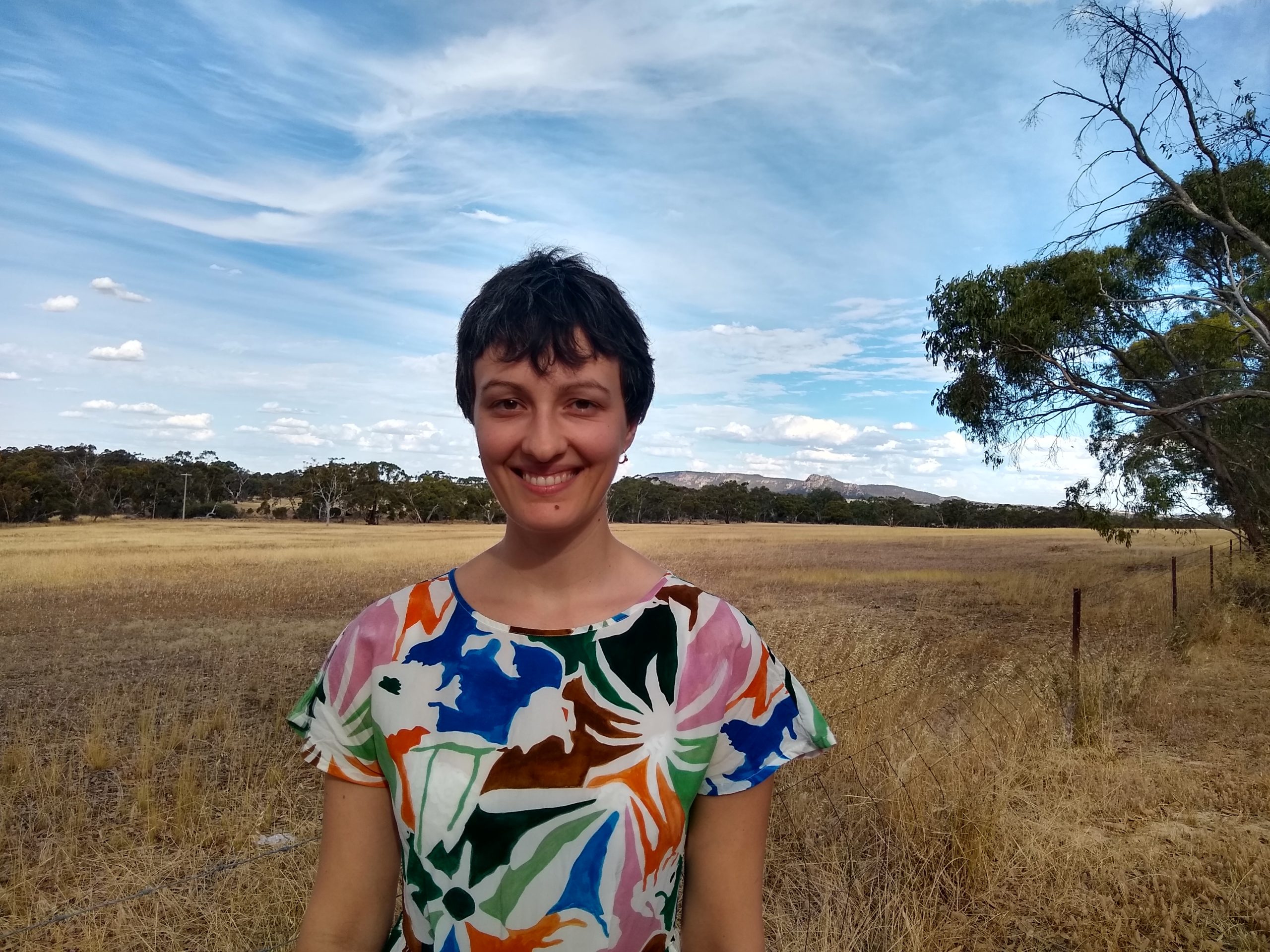
Born in Melbourne, Australia • Studied Applied Mathematics at the University of Melbourne in Australia • Highest Degree Doctor of Philosophy in Mathematical Physics • Lives in Melbourne, Australia • Occupation Research Scientist

I discovered my love of maths in high school when we started learning algebra. I had never been particularly adept at arithmetic or memorising times tables, but algebra was fun. It was about learning logical rules and applying them, step by step, to solve a problem that seemed impossible from the outset. My maths career so far has taken me from applied maths to mathematical physics to statistics and data science. Though the technical areas have been different, the pattern of understanding fundamental rules to break down big problems has remained.

I followed my heart all the way to a PhD in mathematical physics where I discovered the beauty of diagrammatic algebras: equations made out of squiggly diagrams.

My decision to pursue a career in maths came during my second year of university. I had been studying engineering, which I believed to be a more stable career choice, but after a year and a half I couldn’t get excited about any of the engineering specialisations. My Mum encouraged me to follow my heart and study mathematics: study what you love and you’ll figure out the work later, she advised. I followed my heart all the way to a PhD in mathematical physics where I discovered the beauty of diagrammatic algebras: equations made out of squiggly diagrams.

After a two-year postdoc in Italy, I decided to make the switch from academia to follow a career in data science. I had avoided any statistics and probability in my university studies, because they were not topics I enjoyed in high school, but I soon learned how interesting randomness is and how useful it is for understanding the world. I was lucky enough to land a dream job at Data61, the data analytics unit of CSIRO, Australia’s national science agency. Since then I have been working on industry projects, solving applied problems in the areas of manufacturing, wildfires and public policy with statistics and machine learning. I love that even after this career change, I can still use my mathematical thinking to break problems down into their essential ingredients and solve them step by step.

Reflecting on my path from education to employment, I have learnt that careers don’t have to follow a clear and straight path.

Reflecting on my path from education to employment, I have learnt that careers don’t have to follow a clear and straight path. I have learnt that following your dreams can be a good option, but it isn’t the only one, and that trying out adjacent areas of work that are in-demand can lead to a fulfilling occupation. I have also learnt that an important output of your studies is the ability to teach yourself new skills, because flexibility is a valuable skill in the workforce – plus learning new skills keeps your work interesting.

Published on February 2, 2022.

Posted by HMS in Stories