
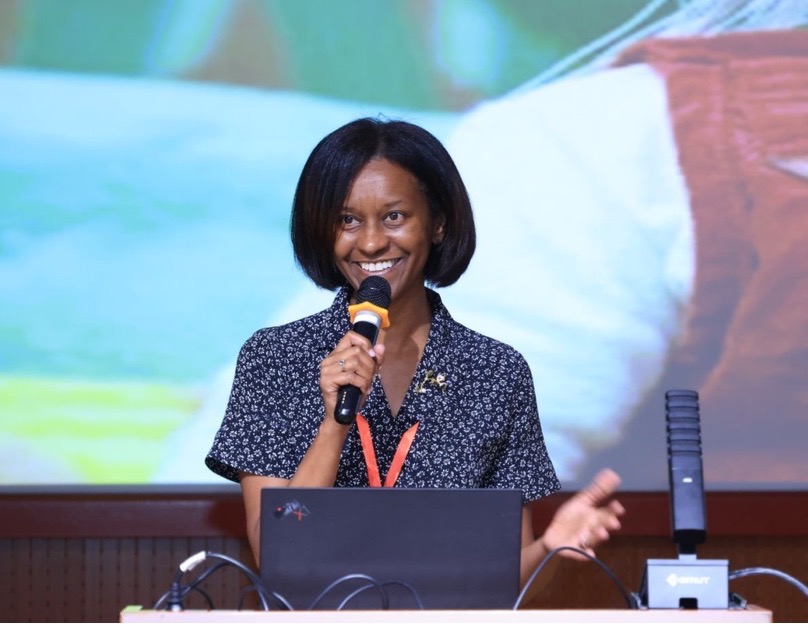
Born in Brazil • Studied Psychology and Neuroscience • PhD in Science • Lives in the United Kingdom • Director of the Music and Math Cognition Lab at University College London, Institute of Education, and Member of the UNESCO Inclusive Policy Lab
As a multiethnic and multilingual woman in cognitive and developmental neuroscience, I have often found it difficult to be encapsulated by stereotypes. I have studied and worked in environments where ethnic imbalances persisted. I often wish I had encountered role models who looked like me in such spaces, although I remain grateful to everyone who inspired and supported me in many ways throughout my journey.
During my residency in neuropaediatrics and PhD in the Faculty of Medicine at the Federal University of São Paulo, I developed a strong interest in translational and experimental approaches, focusing on human cognition and neurodevelopmental conditions. In my PhD I examined working memory in children with congenital encephalopathies using neuroimaging and behavioural tasks to understand brain plasticity patterns.
(…) I have developed experimental interventions such as musical training, digital games, and safe, non-invasive brain stimulation aimed at enhancing learning processes in children who experience difficulties in mathematics
Years later, my research interests shifted towards mathematical cognition, brain mechanisms, and developmental dyscalculia, prompted by noticing a benefit in maths performance in a study conducted by one of my undergraduate students on children’s musicalisation. Since then, integrating neuroscience, psychology, and education has been central to my work, enabling me to examine how mathematical skills develop and how learning can be optimised through evidence-based approaches. For instance, in collaboration with colleagues and students, I have developed experimental interventions such as musical training, digital games, and safe, non-invasive brain stimulation aimed at enhancing learning processes in children who experience difficulties in mathematics.
My career trajectory has been more spiral than linear, spanning positions in Brazil, Portugal, Spain, and Ireland. Working in diverse academic environments has been enriching, fostering malleability, exchange, and awareness of cultural nuances. I am currently in my third academic tenured post. Although each move represented advancement, it often required restarting at a lower rank. Within the status quo, I reflect on the importance of empowering academics to recognise the value of their contributions and to negotiate their working contracts.
My vision is to develop tailored interventions for low-achieving learners, examining neural mechanisms of individual differences in maths attainment and the role of social factors in development and compensatory strategies
Despite personal and professional challenges, my outputs include several edited books and numerous co-authored articles with international collaborators, using diverse methods and samples. Alongside extending my music science research, I aim to build an interdisciplinary team using cognitive, affective, and behavioural neuroscience to address real-world challenges in mathematical cognition across the lifespan. My vision is to develop tailored interventions for low-achieving learners, examining neural mechanisms of individual differences in maths attainment and the role of social factors in development and compensatory strategies. Crucially, interventions must be multilayered; without engaging students, teachers, parents, and policymakers, meaningful improvements in mathematics education are unlikely.
Mathematics has offered many rewarding and memorable moments. One particularly humbling experience occurred at an event organised by the Institute of Physics of the United Kingdom and Ireland, where, during parallel sessions, a physicist cancelled her presentation to attend my talk on mathematics anxiety, enabling a shared discussion across STEM and social science fields. Another honour was being featured in Irish Maths Wall Calendar (2016–2024), published by the Annals of Irish Mathematics and Mathematicians, alongside outstanding contributors to the field.
Most projects I have led or co-led focus on improving mathematics education, supported by the Irish Research Council, the Leverhulme Trust, and Erasmus+. The Arithmós Project, for example, produced resources including a cartoon video, teacher workshops, a digital game intervention, and policy briefs. This work led to my participation in Games for Change, organised by UNESCO and hosted at Rubika in India, where I highlighted the importance of multilayered approaches in game-based learning and the need for collaboration between game developers and cognitive researchers to produce sound content for mathematics education.
I believe careers in neuroscience should be accessible and attainable; most pathways still favour elites and do not globally capitalise on talents
At UCL, I contribute to research and teaching in cognitive and developmental neuroscience. I also serve as an Athena Swan representative, supporting gender equality in academia. I collaborate internationally across East Asia, Europe, and more recently Africa, and support students in developing rigorous, globally relevant research.
I believe careers in neuroscience should be accessible and attainable; most pathways still favour elites and do not globally capitalise on talents. That is why I led initiatives such as Brain and Maths in Ibero América, which freely boosted the visibility of Latin American researchers. I also engaged with mentorship programmes such as Black in Neuro, ALBA Network, and Society for the Improvement of Psychological Sciences, as early career researchers benefit from role models. Furthermore, I have served a two-year term as Chair of the Mathematical Cognition and Learning Society, fostering an inclusive international community of more than 400 researchers grounded in integrity, open science, and pipeline knowledge.
Looking back, I would encourage my younger self to seek advice more often; mentorship helps you to skip unnecessary steps. I would again embrace translational research and remain open to combining different professionals and interests, such as music and maths, as many meaningful advances in my work have emerged from bridging fields. I aspire to build a legacy through a meaningful academic career, contribute to the science of learning, and support and inspire students, particularly those who may not see themselves represented in academia.
Published on September 2, 2026.
Recent Comments