WomenInSTEM

Poetry as Lens: Two Historical Women Mathematicians

Poetry as Lens: Two Historical Women Mathematicians

by Jessy Randall

In 2015, I attended a talk on Sarah Frances Whiting given by Colorado College physics professor Barbara Whitten. Whiting was part of a group of women who cataloged stars at Harvard University in the late 19th century. I sat in the audience scribbling notes about these amazing women – I always listen better with a pen in my hand – and got particularly interested when Whitten showed a slide of a murky blob, an example of the star photographs these women used in their work. To my eyes, it looked like nothing much. Really just a smear.

After the talk, I looked up additional information. (Did I mention I’m a librarian?) I learned that one of Whiting’s colleagues, Annie Jump Cannon, cataloged hundreds of thousands of stars and, years later, could still recognize and identify the blurry photos she’d used doing that work. I pictured her being shown a blobby shape and saying “Oh, yes, that’s good old XZ437583, I remember that one.” Or “Hello, PQ2843b!” I started writing poems about Cannon, persona poems written from what I imagined to be her point of view. 

Annie Jump Cannon (1863-1941)
(first appeared in Asimov’s)
 
1. Annie Jump Cannon Cataloged Stars
 
Annie Jump Cannon
cataloged stars.
 
The work was tedious.
The pay was terrible.
 
But every day for forty years
she went to work
and held the universe together.
 
2. Annie Jump Cannon Goes Home from the Lab
 
She can’t stop seeing them:
the photographs,
black and white smears of stars.
 
They look like throwaways.
They look like nothing.
But not to her, to her they’re clear
 
as alphabets, because 
she’s good at what she does.

Her name led to others, and I found myself spending my lunch hour in the science section of the Colorado College library stacks. Soon my desk was piled high with thick books about historical women in STEM fields. There were SO MANY MORE women scientists and mathematicians than I ever knew. Than I ever dreamed! I wrote a lot more poems. 

Around this time, some powerful men bragged that with enough fame and power, they could get away with anything, including sexual assault. This made me really mad. So mad that I decided to do something about it! But as a librarian and a poet, what could I do, exactly? Well, I wrote a collection of poems about historical women in STEM fields. Maybe not the most effective form of resistance, but the project staved off my feelings of helplessness and hopelessness. 

I got particularly attached to a set of “biobibliographic source books” edited by Louise S. Grinstein,* and went through them page-by-page looking for women to write about. Frequently, some detail of the lives or work of these women leapt out as a perfect metaphor. When I read the entry on Soviet mathematician Nina Bari, the phrase “mathematics for ladies” led to this poem:

Nina Karlovna Bari (1901-1961)
(first appeared in Strange Horizons)
 
After the revolution, she passed the boys’ exam 
and became the first woman in the Luzitania,
students of Nikolai Luzin known for 
their interest in a new kind of math,
 
descriptive math, something more like 
philosophy, sometimes described as
mathematics for ladies.
 
This particular lady worked on functions
converging “almost everywhere”
(a precise term in trigonemetricheskii)
 
and she herself converged almost everywhere, too:
Paris, France; Lvov, Poland; Bologna, Italy;
even a mountain pass named for her lover, Nemytski,
whom she later married.
 
She married Nemytski, but some say her real love
was Luzin. They say she was despondent at his death,
and that when she was not yet sixty (in other words, 59), 
she threw herself in front of a Moscow Metro train.
 
There’s no way to know. It could have been an accident.
But when a woman had made her name calculating 
functions that converge almost everywhere,
we have to think she knew what she was doing.

In the 1920s in the Soviet Union, “mathematics for ladies” (математика для дам / matematika dlya dam) was a derogatory term for descriptive mathematics such as function theory. As in English, the word for “ladies” in Russian has a different connotation than the word for “women” – ladies (дам / dam) being more fancy and posh, not the Soviet ideal of real-world working women (женщины / zhenshchiny). 

I found this idea pretty hilarious. A special kind of math just for women? Different math for different genders? Aren’t numbers the same for everyone? Numbers and formulas and equations don’t change depending on your gender. But then I remembered those statistics about the gender pay gap – that for every dollar a man makes, women make 84 cents, or 90 cents, or 66 cents, depending whom you ask. 

In Bari’s time, math was supposed to be for practical purposes: engineering, architecture, and so on. “Mathematics for ladies” wasn’t real math – real mathematicians considered it to be useless, more like philosophy than math. Much has changed in the past hundred years. Abstract math, or pure math, is now standard in college and university math programs, and pure math scholars receive as much respect as their comrades in applied math (if, perhaps, not always as much funding).

For more information about the books, links to online poems, and subject indexes, visit http://tinyurl.com/MathforLadies.

Literature

*Women of Mathematics: A Biobibliographic Sourcebook. Ed. Louise S. Grinstein and Paul J. Campbell. New York: Greenwood, 1987.

*Women in Chemistry and Physics: A Biobibliographic Sourcebook. Ed. Louise S. Grinstein, Rose K. Rose, and Miriam H. Rafailovich. New York: Greenwood, 1993.

*Women in the Biological Sciences: A Biobibliographic Sourcebook. Ed. Louise S. Grinstein, Carol A. Biermann, and Rose K. Rose. New York: Greenwood, 1997.

About the author

Born in Rochester, New York, USA. Studied English Literature at Columbia University in New York City. Master’s Degree in Library Science from UNC-Chapel Hill. Lives in Colorado Springs, Colorado. Curator of Special Collections at Colorado College and author of two collections of poetry about historical women in STEM fields: Mathematics for Ladies (Goldsmiths Press, 2022) and The Path of Most Resistance (Goldsmiths Press, 2025).

More information: http://tinyurl.com/MathforLadies

Published on September 17, 2025.
Photo credit header: Nethery Wylie

Posted by HMS in Blog
Jyoti U. Devkota

Jyoti U. Devkota

Born in Nepal Studied Mathematical Statistics at Lady Shri Ram College, New Delhi, India • Highest Degree PhD in Mathematical Statistics at the University of Osnabrück, Germany • Lives in Kathmandu, Nepal • Occupation Professor of Statistics and Mathematics

I had a great interest in mathematics right from my childhood. The beauty of mathematical problems and its solutions always captivated me. The logical approach followed towards solving a mathematical problem, the exactness and preciseness of its solutions, was always a source of great fascination. As a school student, I was always in the quest of a solution to the mathematical problems given by my mathematics teacher, in the classroom. During my student life in school and college, I was always ready to tackle that mathematical problem for a solution. 

While growing up, my mathematics teachers in my school and my college were my role models. But I didn’t always have a good mathematics teacher in the school. Some teachers, although quite knowledgeable, could not explain mathematics in a simple language. In the pre-Internet and Communication Technology (ICT) era, those were the times of great struggle, as a student. Access to good quality study materials in mathematics was limited to teachers, in those times. Despite having very limited good quality educational resources in mathematics, I have tried to persevere as a student, professional and a researcher. Mathematics has always been a labor of love for me.

Despite having very limited good quality educational resources in mathematics, I have tried to persevere as a student, professional and a researcher. Mathematics has always been a labor of love for me.

After studying Mathematical Statistics in India and completing my PhD in Germany, I returned to Nepal, where I have worked now in the Department of Mathematics at Kathmandu University for more than 25 years.  In this university, I have delivered lectures on several courses of Statistics and Mathematics at the undergraduate, graduate and postgraduate levels. My main objective has been to popularize these courses among my students. To achieve this, I have always tried to simplify formulas and make them engaging for the students. I have also offered crash courses in advanced levels of Statistics and Data Analysis to interested students and researchers. I have also focused on the interdisciplinary applications of the subject. I have taught students from many disciplines including medicine, engineering, environmental sciences and social sciences. My main aim has always been to promote data-based interdisciplinary studies. This was done by making mathematics interesting and popular among my students.

My main aim has always been to promote data-based interdisciplinary studies. This was done by making mathematics interesting and popular among my students.

I faced some challenges while starting my career as a professional like all my male counterparts. This was due to the switch over from student life to the life of a professional. I experienced at that time that the atmosphere in the classroom as a student was completely different from the atmosphere in the university as a lecturer. In due course of time, I married and had two children. In the initial years of my marriage and motherhood, balancing my married life and my motherhood with my professional life was the source of a great challenge. At that time, due to a Gender Gap in the professional fields of Nepal, I had to figure out how to balance my life. There were no female peers in this field, who could guide me through this part of my life journey. At that time, female professionals were much less in number than male counterparts. My family supported me during this time. I left my daughter with my parents, during my PhD study. 

In the initial years of my marriage and motherhood, balancing my married life and my motherhood with my professional life was the source of a great challenge. [..] There were no female peers in this field, who could guide me through this part of my life journey.

I have to state that there is a Gender Gap in STEM education. STEM subjects seem to be less popular among girls. I feel that girls can break the glass ceiling through their hard work and perseverance in Mathematics and its allied subjects. A sound training in mathematics and its allied subjects prepares them to look at a problem from a different perspective. Girls with enhanced skills in mathematical problem solving are more evidence based and thorough. Mathematics is said to be the language of nature. Thus, these skills have immense scope of interdisciplinary applications. 

With Internet and communication technology, girls of Nepal can be as good as their counterparts in the developed country. By using this technology, girls of Nepal can enhance their skills of problem solving, using mathematics. They should be encouraged to participate in Mathematical events, as this will expose them to the importance of mathematics and the role of ICT in enhancing their skills in mathematics.

Published on June 26, 2024.

Posted by HMS in Stories
Sanchita Chakraborty

Sanchita Chakraborty

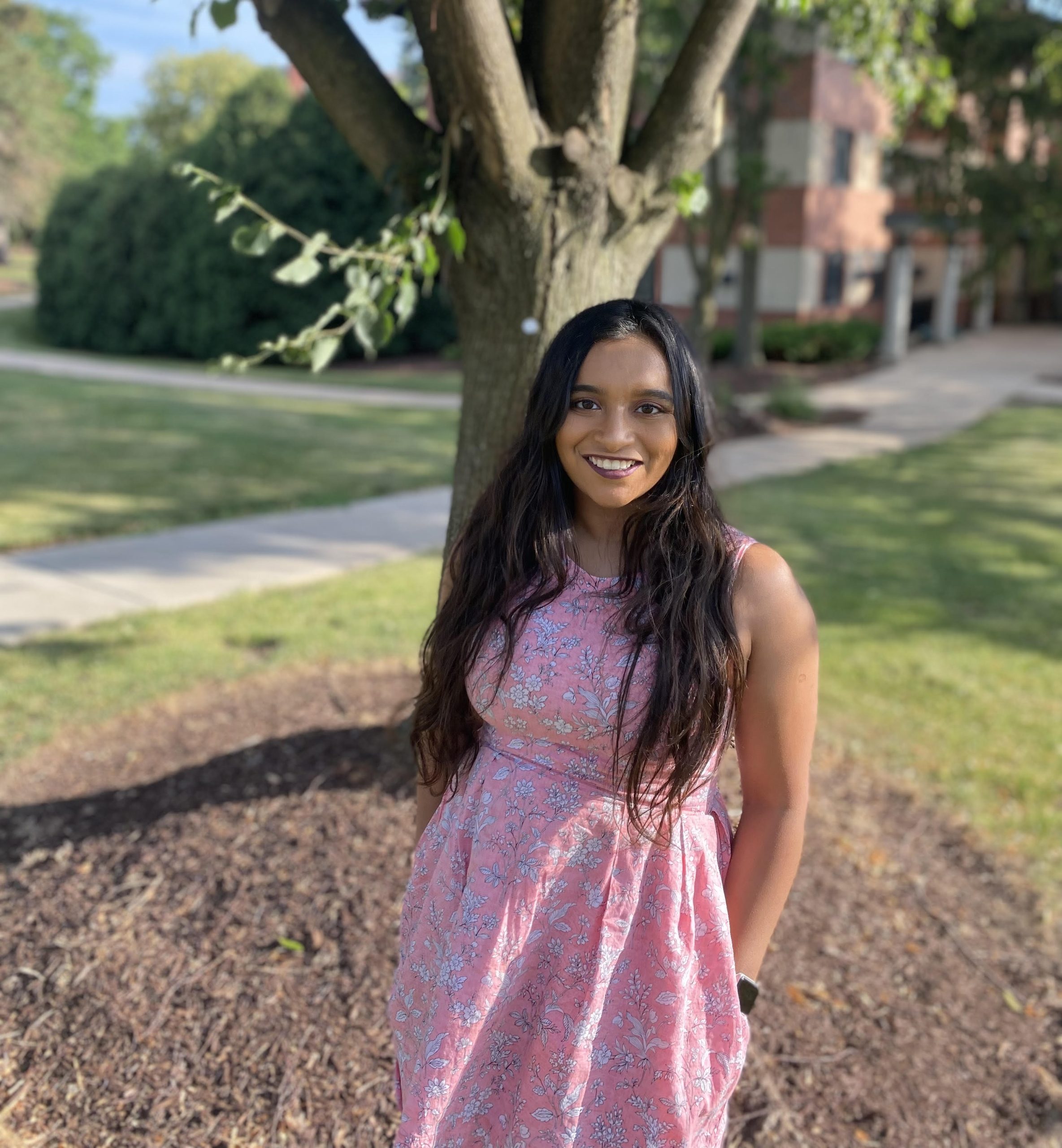
Born in Bolpur, West Bengal, India • Birth year 1999 Studies Mathematics at Purdue University in West Lafayette, Indiana, USA • Highest Degree ongoing Bachelors of Science • Lives in West Lafayette, Indiana, USA • Occupation Student Researcher and Undergraduate Student

I always loved how neat math was. No matter the problem, the answers seem to come with a simple number. After taking partial differential equations and numerical analysis courses, it seems so silly now, the subject is anything but “neat”. It is complex, chaotic, and elegant, but what I have come to appreciate is its beauty, its ability to explain the world around us.

When I imagined a mathematician, I thought of an old man sitting in a flickering candle-lit room with melted wax and papers strewn around on an old wooden table. What did that really mean in the era of supercomputers, high-speed trains, planes and rockets?

As a child, I never really thought of being a mathematician as a job to pursue. I mean, to be fair the greats that I knew of only existed in Ancient Greece or Rome. When I imagined a mathematician, I thought of an old man sitting in a flickering candle-lit room with melted wax and papers strewn around on an old wooden table. What did that really mean in the era of supercomputers, high-speed trains, planes and rockets?

[..], I took the route of role models like Howard Wolowitz from the Big Bang Theory and Dr. Amelia Brand from Interstellar, and chose a degree in Aerospace Engineering.

So, when I had to choose a degree to study, I took the route of role models like Howard Wolowitz from the Big Bang Theory and Dr. Amelia Brand from Interstellar, and chose a degree in Aerospace Engineering. When I entered, I was excited by the engaging new problems I would learn to solve – whether it was in understanding rocket propulsion or in the use of orbital mechanics within navigation. However, instead I became bogged down with solving mundane structures and material problems. Moving into my sophomore year, classes did become more interesting with my first fluids and orbital courses. Every time I stepped into an engineering classroom, I felt a sense of excitement in understanding the fundamental equations, rather than the applications to real-world problems.

While I had once run away from engineering, I found myself right back to where I began, but instead I was in the role of a mathematician.

I reflected on my prior math courses, thinking about how I would apply these geometric properties and analysis techniques to problems that I had been introduced to in my aerospace courses. I knew it was time for a change, so I switched gears to classes like complex analysis, partial differential equations, and introduction to proofs. I was hooked. Around the same time, I had my first laboratory experience in mathematics. I spent the summer working on neural networks to reduce the loss from the 2D approximations to the advection-diffusion equation in transport phenomena. It was one of the hardest learning experiences, coming in with very little knowledge of Deep Learning, but the hours spent on literature reviews seemed less like work and more like unravelling my favorite mystery novel. This was the moment in which the puzzle pieces of all my interests across engineering and mathematical disciplines clicked.  So when I finished my summer project, I immediately looked for new opportunities in applied mathematics, and I was fortunate enough to find a supervisor in the Electrical and Computer Engineering department to work on Finite Element Methods and the Schrödinger equation. While I had once run away from engineering, I found myself right back to where I began, but instead I was in the role of a mathematician. My supervisor has helped me find confidence in my abilities and given me the opportunity to take lead on my first project, and is the reason I have found the confidence to apply to applied math MS/PhD programs for fall 2022.

I had women like Katherine Johnson to look up to, but she was merely a role model, not an individual I could tangibly connect to.

While I have been undoubtedly lucky to be surrounded by amazing mentors, the lack of women mathematicians and engineers did not go unnoticed. I found my experiences to be hardly unique. When talking to a good friend in the math department, I found that she too had been the only woman in her math classes. In four years, I had only had one woman math professor and one woman graduate student that supervised my research. In my graduate and advanced courses, I was one of two or maybe three women students. The world had long moved away from the old man in the candle-lit room, but the representation of women in the industry was grossly underdeveloped. Looking at research faculty in the graduate programs I applied to, I found the representation to be quite similar. I had women like Katherine Johnson to look up to, but she was merely a role model, not an individual I could tangibly connect to. She seemed just as far remote as the Greek greats.

Inequality seems to be quite an abstract notion and equality just an idealized concept, existing only in philosophical treatises. To encourage more women to pursue a career in academia and research, we must begin by creating real mentor-mentee relationships that go far beyond the professional. Only through this tangible bond can we expect to see true equality in every field, including this complex and elegant language we hold so close and I sincerely hope that one day the word mathematician comes with an image of a woman and a man working side by side in a world intertwined with modern technology.

Published on February 16, 2022.

Posted by HMS in Stories