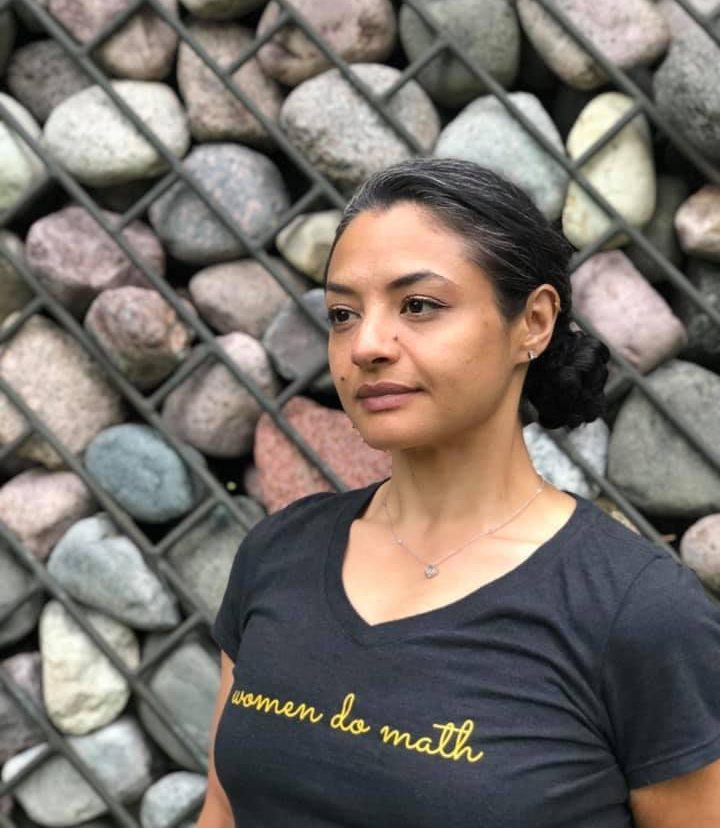
Born in Guadalajara, Jalisco, Mexico • Birth year 1983 • Studied Mathematics at University of Wisconsin, Milwaukee in Milwaukee, WI, USA • Highest degree PhD in Mathematics • Lives in North Adams, MA, USA • Occupation Mathematics Professor
My love for math faded during my high school years. Being undocumented, living in the United States was challenging. Even though I was doing well academically, I thought I might never have the opportunity to attend college. I was sad, and at that time I turned to art as an outlet to deal with the challenges I was facing. I spent most of my senior year in high school in an art studio. I spent countless hours learning to draw, paint, and sculpt. I even dropped out of my calculus class just so that I could have more time to do art. I do not regret that choice, even though going a year without math courses hurt my mathematical skills. At the time, I needed something to help me deal with the anxiety and sadness I was experiencing, and art served me well.
There I had a meeting where my mentor said “when you go to graduate school”. I had no idea what graduate school was, but I knew that if she believed in me, then I should go to graduate school.
After graduating high school, I was able to enter community college. How that was possible is a story for another day, but the main thing is that, upon entering the program, my mathematical skills were well below calculus. My first college math course was intermediate algebra, where I (re?)learned how to factor polynomials. I vividly remember that day’s lesson where the professor said “To factor x^2+5x+6 we need to find two numbers that add to 5 and multiply to 6.” I immediately raised my hand, proudly announcing that numbers did not do that. How can two numbers multiply and add to something different? Luckily, the professor was very kind and she allowed me to think of examples. After discovering that 2 and 3 did the trick, I felt such joy in understanding something that I had taken for granted: numbers are amazing and in fact multiplication and addition are two distinct things! From there my story began to take shape.
After intermediate algebra I took all of the math courses the community college offered and later transferred to a four-year college to continue studying math. There I had a meeting where my mentor said “when you go to graduate school”. I had no idea what graduate school was, but I knew that if she believed in me, then I should go to graduate school. So, on I went!
My professional mission is to ensure that mathematics is a welcoming place for everyone, and I am eager to keep working on this for as long as I live.
I always knew that I would like to be a teacher. There is something so beautiful about seeing someone understand something. Most people call that an “aha” moment, and it truly is special. I also knew that education is a path out of poverty and into opportunity. Being an immigrant, I knew firsthand that having options is one key component to a happy life. So, I have always wanted to help others reach their goals and attain their dreams. However, it was not until almost the completion of my PhD that I decided to be a college professor. Finding this as a career option was great because it has allowed me to continue learning while doing research and teaching students. Creating new programs and platforms that provide mentorship and support for students from groups who have been historically excluded from higher education has also been deeply fulfilling. This outreach work keeps me grounded and reminds me that there is still a lot of work to be done in order for everyone to have meaningful and positive experiences with mathematics. My professional mission is to ensure that mathematics is a welcoming place for everyone, and I am eager to keep working on this for as long as I live.
Throughout those early years I could have used a larger community of support and to see others like me occupy positions and careers like those I had an interest in.
Being an immigrant, previously undocumented, and a Latina woman meant I rarely saw people like me in mathematics. Throughout those early years I could have used a larger community of support and to see others like me occupy positions and careers like those I had an interest in. Sadly, it took a long time to find a community of scholars who shared similar backgrounds and heritage. Yet this motivated much of my past work and inspired me and Drs. Alexander Diaz-Lopez, Alicia Prieto Langarica, and Gabriel Sosa to co-found the organization Lathisms: Latinxs and Hispanics in the Mathematical Sciences. Our goal is to share and amplify the contributions of Latinx/Hispanic scholars in math. We do this through a variety of means including Hispanic Heritage Month (in the US it is celebrated between September 15 and October 15) events, a podcast, and even a new book — Testimonios: Stories of Latinx and Hispanic Mathematicians. The book’s chapters will be freely available one per month starting in September 2021 and our hope is that this book provides a way for those within the community to learn of our stories while also giving advice to those who want to learn more about us and how to support our work. Although there is much work to be done so that those from historically excluded groups feel valued and uplifted in mathematics, I am hopeful that initiatives like Lathisms are making this reality possible.
Born in Steinfurt, Germany • Studied Maths at the University of Münster, Germany • Highest Degree Doctorate in Maths • Lives in Steinfurt, Germany • Occupation Software Developer at LVM Versicherung (insurance company)
When I started studying maths, I was frequently asked what I was planning to do after graduating. “Who wants to hire a mathematician? Do you want to end up in a boring job working in the financial sector or in an insurance?” Of course, like most of my fellow students, I did not have a satisfying answer to these questions. Today, after several years of studying and struggling with lots of formulas, proofs and theorems, I have learned two very important lessons: First, that there are thousands of opportunities in very different branches of industry and academia a mathematician can take, and second, that having an inspiring and exciting job and working for an insurance is not a contradiction.
And what came next finally took me to the decision to stay with maths for the rest of my life: I realised that I was not the worst student (though not the best either), and I was fascinated by the clarity and pure logic of mathematical problems, forming a huge contrast to the, in my opinion, very unclear analysis of poems and classic literature (sorry to those who would disagree with this point).
In my experience, studying maths is a decision made out of the interest for logical structures, for clarity and puzzles, but not for a particular future job. Unlike many others, the presence of this interest was not clear to me until I reached the last years of high school. Thus I cannot claim that I had always been fascinated by mathematics, though I was never a bad student, my interests lay elsewhere – largely in learning languages, which I still try to spend some time with beside my current job. This changed due to a sudden and, at least in retrospect, very fortunate coincidence: When I had to choose my advanced courses for my last two years at school (every German academic high school student has to decide for two), due to organisational reasons I ended up in the advanced maths class. For a few weeks, I was quite depressed, being sure that I would be the most stupid student next to all those maths geniuses. And what came next finally took me to the decision to stay with maths for the rest of my life: I realised that I was not the worst student (though not the best either), and I was fascinated by the clarity and pure logic of mathematical problems, forming a huge contrast to the, in my opinion, very unclear analysis of poems and classic literature (sorry to those who would disagree with this point). Out of this fascination I finally made the decision to study maths, without having a specific career aspiration and even without having any idea about possible careers.
Although in my opinion, society made great progress in overcoming gender-specific obstacles, I also made the experience that women interested in computer stuff are still a bit unusual. This caused me to be suspicious – would I be good enough, would I be able to establish myself in this branch and would I find a job as a mathematician?
At the university, I fought my way through the first few semesters without a specific plan – but instead with lots of very close new friends with the same mind-set, since studying maths is not least a matter of team work. In my fourth semester, I first encountered the field of numerical mathematics, which, roughly speaking, can be explained as the area of intersection between maths and computer science. I realised how closely related these two fields are: Computer science can be used to solve lots of mathematical problems, while every computer program uses the “language” of mathematics and logics. I was fascinated by the variety of applications and decided to concentrate on this field in my further studies. And slowly, very hesitantly in the beginning, I started thinking that maybe I could become a software developer. Hesitantly because up to this point, I never had any points of contact with computer science in my life, not because I was not interested, but simply because it never came to my mind. Although in my opinion, society made great progress in overcoming gender-specific obstacles, I also made the experience that women interested in computer stuff are still a bit unusual. This caused me to be suspicious – would I be good enough, would I be able to establish myself in this branch and would I find a job as a mathematician? To find the answers to all these questions, I needed to try it out – so I tried, and it was worth it.
Before this rough idea could emerge to a specific plan, a few more years had to pass by. After graduating, I was still insecure about what I wanted to be. Not only, but also not at least in order to postpone a “final” decision, I decided to stay at the university and do a PhD, despite again fighting with my doubts of being good enough. This turned out to be a great idea – I was now able to contribute my own ideas and, in this way, further develop my interests and strengths, all the time attended by a great, supporting and understanding scientist. And although I was for sure not the best student (thanks to my supervisor’s patience at this point), I finally made it, having learned one of the most important lessons in life: You can do it if you really try.
At this point in my life, I knew what I wanted: To use my mathematical logical knowledge in combination with my (at this point, quite acceptable) programming skills to contribute to something “tangible”, something someone could really make use of […].
After finishing my PhD (and now, with a particular plan, namely to become a software developer), I applied for my first job outside of academia. At this point in my life, I knew what I wanted: To use my mathematical logical knowledge in combination with my (at this point, quite acceptable) programming skills to contribute to something “tangible”, something someone could really make use of (sadly this is something missed by many maths students during their studies). The explicit sector was not important for me, since I found for myself that those really deep and specific programming problems are fascinating no matter if the application behind is just a web-enabled water boiler. So I thought, why not an insurance company? The job advertisement sounded very interesting. The company was looking for developers for a completely new contract software, which would be used by the insurance agencies all over Germany. This promised not to be the boring insurance job every first-year maths student is afraid of, so I took the chance. Retrospectively, I am very happy about the path I took, and proud of having had the courage to take it, regardless of my doubts and fears of not being good enough. Although this is something several maths students have in common, most of my former fellow students also share the ability of tenacity, they do not give up easily, but make their way and realise that it works – in the end, the struggle was worth it and I would strongly recommend to just give it a try.
Born in Quito, Ecuador • Studied Mathematical Engineering at Escuela Politécnica Nacional in Quito, Ecuador • Highest Degree M.Sc. in Mathematical Optimization • Lives in Quito, Ecuador • Occupation Teaching assistant and Ph.D. student
My math story started with questions, as many other math stories, I suppose. In the early years of high school, math exercises were fun and challenging. I enjoyed solving them, but I never thought I would study math as a career years later. By that time, I wanted to become an engineer, like my dad, and hopefully work at a hydroelectric power plant. But somehow, math was like gravity, and I felt more and more drawn to it. Hence, I decided to study math at Escuela Politécnica Nacional in Ecuador at the end of high school. Looking back on it, I think I was lucky. Pursuing a career in math was not common in Ecuador. I had the support of my parents and I also was encouraged by my math teacher. However, I had no idea of what math was really about.
I enjoyed the vitality of the formal math language, which brings the possibility to precisely describe a deduction process and articulate a definition from an intuitive notion.
I found the early stages of my undergraduate studies challenging and, sometimes, difficult. However, I was amazed and triggered. I enjoyed the vitality of the formal math language, which brings the possibility to precisely describe a deduction process and articulate a definition from an intuitive notion. The beauty of the simplicity and richness of math made me stay. Nevertheless, the inflection point in my math story happened when I started to work as a research assistant in a project at the Research Center for Mathematical Modeling in Ecuador, ModeMat. In this project, I worked on the numerical solution of visco-plastic fluids. These fluids have a dual behavior; they move like a solid or like liquid depending on the stress imposed on them. I found the mathematical formulation of these fluids fantastic. In this process, I learned the fundamental laws underlying fluid dynamics, optimization methods and I improved my coding skills. This was the starting point of a journey that led me through a Master’s program in Mathematical Optimization and then, like the flow of a Newtonian fluid, to the Ph.D. program in Applied Mathematics. Being part of the Research Center, ModeMat, has shaped part of my life. I have grown up there from an undergrad student to a Ph.D. student under the supervision of four great advisers: Pedro, Sergio, Juan Carlos, and Luis Miguel. Their guidance during the Ph.D. has been essential and valuable.
I am confident things are changing. At the moment, in my Ph.D. program, we are more women than men.
Nonetheless, I have realized that every time I was part of an international conference, unconsciously I ended up choosing a woman from the Academy as a role model. This unaware action, years later, made me realize how important visibility is. There were few academic women at the math department while I was an undergrad student; therefore, I had the chance to only have one math woman professor. I am confident things are changing. At the moment, in my Ph.D. program, we are more women than men.
I am in the last year of the Ph.D. This journey has not been like the stream of a calm river. Like a visco-plastic fluid, sometimes I have moved like a solid, slowly and without any change in my progress and, sometimes, one just flows like a liquid in a stream of exquisite results. The chance to write about my story came in an opaque moment of uncertainty and lack of confidence. It took me a while to sit and write it down. However, I have genuinely enjoyed it. This retrospective exercise helped me to reconcile and reconnect. Right now, I am focused on this last year of the Ph.D. and interested in a Postdoc. My thesis is still related to visco-plastic fluids. Therefore, in some sense, I think I kind of accomplished my teenage dream. I am not working at a power plant driven by water but I have a better understanding of the fluid dynamics laws to comprehend the power of water. Finally, I would like to take the final words of Natasha Karp’s math story (which I enjoyed a lot reading) as advice: “Enjoy your journey but don’t expect to know exactly where you are going and keep growing and challenging yourself’’. I think that’s what I will do.
Born in Braunschweig, Germany • Studied Math (diploma) at the Technical University in Braunschweig, Germany • Highest Degree Doctorate in Math (Dr. rer. nat.) • Lives in Meine, Germany • Occupation Professor at the Hochschule Hannover – University of Applied Sciences and Arts, Department of Business Information Systems, Field of Data Science
Analytical thinking has always been easy for me. Therefore, I enjoyed the rules and patterns that occur in math from early on. Luckily, I recovered quickly after the German high school greeted me with the minimum pass mark “adequate” in the first two math exams in 7th grade. In 9th and 10th grade, we had a very strict “old school” teacher who left a lasting impression. We always had to stand up to greet him, and if you used a swear word in class, you had to wash the glasses in the chemistry room during the next break. He was strict, but he liked me and I learned a lot. In 11th grade I spent a high school year in the US and after this year I wanted to take math as one of my advanced courses. That was a tough decision because all I did at the American high school was statistics whereas in Germany everyone had started with curve sketching. After my return to Germany, the first exam in 12th grade was about this topic. I didn’t know anything about it and I had 6 weeks of summer break to study. A former very kind teacher helped me with the material and I studied by myself and achieved a good mark. That was a major milestone to my decision to study math, since I was able to teach myself the topics of almost a whole school year. But I still wasn’t sure. Math or psychology?
After all the ups and downs you typically encounter during this phase – 3 years for me – I finished my doctoral thesis in math (graph theory) two weeks before my first daughter was born.
Both sounded very attractive to my 19-year-old self. The plans to move to Braunschweig with two of my friends were already settled and I finally chose math because it was giving me a wider range of options on what future opportunities to follow – because I had no clue what to do after my studies at that point. In the beginning we were quite a few students, but in the end only 4 of us were left in pure math – 25% women 😉. I chose most of my courses in abstract math – algebra, combinatorics – and did as little applied math as possible. I really enjoyed the study of group and ring structures and the book Algebra by Serge Lang was always by my side. I already dreamed of becoming a professor myself.
Yet, in the end, the question what to do with all the knowledge I gained crept more and more into my consciousness. That is why I didn’t pursue a strictly academic career, nevertheless I still wanted to secure the option, and chose a PHD position in business at Bosch (formerly Blaupunkt) in Hildesheim. No more group and ring theory, suddenly I had to write code in C++ for algorithms in navigation systems. I had avoided any computer science so far, thus, I was thrown in at the deep end. But I never regretted this step because I discovered that coding is not all at all as difficult as I thought – after all it’s logical – and I learned a lot about working in a bigger company. After all the ups and downs you typically encounter during this phase – 3 years for me – I finished my doctoral thesis in math (graph theory) two weeks before my first daughter was born.
I found the fitting position where I can combine my passion for analytical thinking, my academic background, and my work experience (…).
I stayed home with her and somehow managed the defence of my doctoral thesies with a 5-month-old baby and still deprived of decent sleep. After 8 or 9 months at home, my brain started asking to be challenged again, and I began to apply for jobs in industry. As a young mother I wanted to start part time, but as a woman holding a doctorate in mathematics that was not as easy to get as I hoped. After a long search, including several offers with 40 hours and more, I was finally rewarded by starting a job at VW Financial Services. My one-year-old daughter was able to stay at the company’s own childcare facility and I started with 27 hours a week as a systems analyst in the business intelligence department in IT. In almost 10 years I made my way from analyst, to project lead, to team lead all the way to head of two sub-departments and got enrolled in the management trainee program – most of this in part time including a maternity leave when I had my second daughter in between. Then, suddenly, another option which had gotten a little out of sight but was still a silent dream popped back in.
And that is my way to my current position as a professor in business computing, especially data science. I found the fitting position where I can combine my passion for analytical thinking, my academic background, and my work experience – all of that with the advantage of being my own boss, still doing interesting projects with different companies, giving talks about AI for lay audiences (schools, senior clubs, …), and guiding young people on part of their own story.
Born in Hanoi, Vietnam • Studied Mathematics at RWTH Aachen in Germany • Highest degree: Master of Science in Mathematics • Lives in Utrecht, The Netherlands • PhD candidate in infectious disease modelling at the Julius Center for Health Sciences and Primary Care in Utrecht (The Netherlands)
I was born in Vietnam, grew up in Germany, lived in the UK for about two years in total, and moved to the Netherlands for my PhD four years ago. Having lived in various countries, I always saw myself as a cultural hybrid – bridging the gap between different cultures and traditions. My PhD topic similarly connects two different but intersecting disciplines: I develop mathematical models to tackle the spread of infectious diseases.
When you would have asked me what my future job would be when I was 10 years old, my answer would probably have been “a detective”. I loved solving puzzles and finding solutions to a problem. What I particularly enjoyed about maths was its simplicity: In its pure form, you only need your mind and maybe a pen and a paper.
I knew I wanted to continue to do research in something math-related, but I also realised that I wanted my work to have an impact in the real world.
After graduating high school, I decided to pursue a Maths degree at university. The reason was simple: I was eager to learn more about how to solve abstract problems through logical reasoning. Despite its reputation, you do not need to study maths as a lone wolf. A lot of my university time included working together with fellow students, discussing various solutions, and looking at a problem from different angles. Studying maths at university level was not always easy for me but I had a lot of fun, and I think that’s what counts in the end. When I was about to finish my degree, I felt a bit lost as I realised that I never really had a particular job or career in mind, and I had no real plan for my life. I knew I wanted to continue to do research in something math-related, but I also realised that I wanted my work to have an impact in the real world. However, I had no idea how exactly I could combine these two interests.
By chance, I came across the 80,000 Hours non-profit organisation that tries to guide graduates towards a career that fits their personality but also “effectively tackles the world’s most pressing problems”. This gave me an impetus to contemplate more thoroughly my career choice and I started to do research on the applications of maths to address real-world problems. I quickly learned about the serious risks that infectious diseases pose to our world and how mathematical modelling can provide valuable insights into the field. Luckily, I was able to find a PhD position in infectious disease epidemiology in Utrecht. In hindsight, accepting this position was one of the best decisions in my life as I can genuinely say that I am very happy with my work, my research group, and in particular with my supervisors. They gave me just the right balance between guidance and freedom, and a positive environment to thrive.
Since the start of the COVID-19 pandemic, however, I am using my background to model the spread of SARS-CoV-2 in various settings, for example in hospitals or secondary schools.
When I started my PhD my main topic was to study the transmission dynamics of antibiotic-resistant bacteria in hospitals. Since the start of the COVID-19 pandemic, however, I am using my background to model the spread of SARS-CoV-2 in various settings, for example in hospitals or secondary schools. It has been a very challenging time as my workload has doubled but at the same time, I feel very grateful to have the opportunity to use my skills to ‘do good’ while truly enjoying my work.
The current COVID-19 pandemic demonstrates perfectly that mathematics does not necessarily have to be far from reality, and that it can be a powerful tool for solving real-world problems.
Infectious disease modelling is rather versatile: It requires translating biological problems into the language of mathematics, analytically investigating the research question using the developed model, and finally translating the results back to the real world to obtain implications for infection control policy. The current COVID-19 pandemic demonstrates perfectly that mathematics does not necessarily have to be far from reality, and that it can be a powerful tool for solving real-world problems. Maths used to be underrated and maybe even underappreciated but by showing people how mathematics can be used to stop the spread of infectious diseases, I hope we can spread a little bit more love for mathematics.
Born in Vienna, Austria • Birth year 1994 • Studied Mathematics at Graz University of Technology in Graz, Austria • Highest Degree Master’s in Mathematics • Lives in Graz, Austria • Occupation University Assistant at the Institute of Medical Engineering, Graz University of Technology, Graz, Austria
As far as I can remember I have been in love with math. In school, I always did my math homework first, and I actually procrastinated a bit to spend more time doing math without having to move on to further homework. I was interested in many things as a kid and I was always enthusiastic – this enthusiasm never left! But honestly, I did not realize that being a mathematician could be my job description one day. My mom is a teacher -yes math- so I thought about math only from a teaching perspective for a long time. My dad was a radiologist and I considered becoming a doctor myself. I knew what his daily work and workload was like and I was fascinated by this clear boundary setting between „good“ and „bad“ (he specialized in breast cancer detection and divided tumors he found in “the good, the bad, and the ugly”). Funnily, clear decisions also occur in math! So, for a long time my plan was to apply for medical school after graduating from highschool and my parents generously supported me, not only in terms of financing, but – more importantly – emotionally.
That was the first time I learned about the Fourier Transform – I was so fascinated, I could not stop reading about it!
I was in 11th grade when my mom said, more incidentally: „You know, you always start with your math homework!“. I think she had no idea what she started with that! So, I slightly started thinking: „Could math be an option?“ My social environment was not so supportive, I heard comments like „It is so damn hard, do you want to do it?“ or „Mathematicians just do programming“ (and I hated computers during that time). But I am not a person who is easily influenced and when someone doubts my ability to do something, I usually get in the „I am gonna show them“ mode. During that time I learned that I need to have the faith in myself that others might not have in me! I often sneaked into my mom’s office to read some applied math books and soon she found her missing books on my bedside table. That was the first time I learned about the Fourier Transform – I was so fascinated, I could not stop reading about it!
So my plan changed and my new aim was to go to a technical university. My parents were extremely supportive from day one, believing in me, but also always telling me that I had the option to leave to do something else if math did not turn out to be the right thing. With that in mind, I started university, as motivated as I could ever be, completely oblivious to what will follow. The first months were hard, there is nothing to gloss over here, but not a single second I thought about leaving, I just loved it.
I still enjoyed math a lot, but I got the feeling that I learnt plenty of things „for nothing“ and that I actually wanted to start doing something with it now.
The years went by, I received my Bachelor’s degree with plenty of ups and downs and enrolled in the Master’s program. During this time I was not entirely happy with what I was doing. I still enjoyed math a lot, but I got the feeling that I learnt plenty of things „for nothing“ and that I actually wanted to start doing something with it now. Ultimately, I was unsure if math was still the right subject for me. So, during a Sunday afternoon in the university library where I was unhappy with doing my homework, I scrolled through other institutes‘ webpages, interested in what they do. I spent a few minutes on the webpage of the Institute of Medical Engineering – the curiosity in medicine never left – and there was an open Master’s thesis sounding mathematical, but with an actual application of that. On the next day, I met with the PI (who is my PhD supervisor now) and soon after, I started working on my thesis. I just loved it from day one. I finally felt like being „home“, I could use all the fancy math skills I learned and I could actually utilize them for real-world problems. Eight months and some exams later, I graduated and received my Master of Science in mathematics with specialization in technomathematics. I did not need to think about what to do next for too long, as I knew exactly that I wanted to continue with math. And so I started working on my PhD at the same institute after two months of traveling the world.
I love to do research, to try out new things, to travel to conferences and to get to know like-minded people, and I really enjoy teaching.
For my PhD, I’m working in the field of optimal control for Magnetic Resonance Imaging (MRI). Here, I’m optimizing radiofrequency (RF) pulses, which form the basis of every MRI scan. Goals of the optimization include making the RF pulses shorter, reducing the scan time, and reducing the energy it produces, among others. It allows me to combine mathematical methods with a medical application, namely Magnetic Resonance which is used to obtain images of the human body. During my PhD, my enthusiasm for this subject has not decreased – I grew even more fond of it. I love to do research, to try out new things, to travel to conferences and to get to know like-minded people, and I really enjoy teaching.
At the moment, I have the strong tendency to stay in academia; frankly, I can‘t think about anything else. While writing these lines, we are at the end of the third „Covid-19 wave“ in Austria and I really feel this desire to leave the country and go abroad. Due to Covid, I was not able to travel to international conferences, but as always, this is not an excuse, but a motivation to get going again. I am excited to leave my home and ready to take every opportunity that is presented to me. For the future, I’d like to make the world a little bit better with my knowledge and what I do. Furthermore, I would like to continue sharing the joy of mathematics with my students every day.
Born in Oñati, Basque Country, Spain • Birth year 1984 • Studied Mathematics at Universidad del Pais Vasco/Euskal Herriko Unibertsitatea (UPV/EHU) in the Basque Country, Spain • Highest Degree PhD in Mathematics at UPV/EHU • Lives in Oñati, Basque Country • Occupation Math teacher and Yoga teacher
Curiosity and desire to know are words that describe me quite well. I have always asked myself a lot of questions about everything, and this also happened to me in Math classes, specially in high school. I wanted to know more, go deeper, make sense of all the abstract notions that we were learning. I was the annoying student that asked the uncomfortable questions to the teacher. But I never considered to study Math. Actually, my idea was to study Physical Education, since sports have always been an important part of my life and understanding the biomechanics of the human body has always interested me a lot.
It was my school counsellor who encouraged me to study Math. At the beginning I did not see it very clearly. I thought that I did not fit in with the mathematicians’ stereotypes that I had in my mind. I thought that it would be too hard, that I would have to study so much that it would be difficult to combine with my sport life, since I was playing in a handball team and did not want to give it up. But at the same time this idea appealed to me a lot and I decided to give it a try.
I really enjoyed my undergraduate studies at university. I fell in love with Math. I met wonderful people. Although it was not my plan, thanks to an amazing female professor, I decided to embark on the PhD journey. They were beautiful years, with ups and downs, in which I had the opportunity to travel a lot, to live in different places, to meet many people, to expose myself to new experiences, to learn a lot about Math and also about life, to get to know myself better. It was a rich adventure. I am very thankful that I had the privilege to experience this journey.
It was not an easy decision, but after 8 years since I started my Master, I decided to take a break and I quitted my short scientist career.
After my PhD, I went to Helsinki to work as a postdoc. It was there where I discovered Yoga, and I started asking even more questions about everything in general. I spend few years trying to fit in the lifestyle of academia, trying to find a way of being coherent with myself, my will and my feelings, dealing with millions of doubts about how to find the balance between my personal and my professional life. It was not an easy decision, but after 8 years since I started my Master, I decided to take a break and I quitted my short scientist career.
For me, Yoga and Math are very related. Both try to answer the existential questions of life, each discipline from its own point of view.
Since then, I have been very involved with Yoga. It has become in an essential part of my life. I founded a Yoga studio together with one of my friends in my hometown. For me, Yoga and Math are very related. Both try to answer the existential questions of life, each discipline from its own point of view. Both are abstract and awaken your inner imagination. Both disciplines give you very useful tools to manage your everyday life and to deal with everything that happens in life.
Nowadays, in addition to teaching yoga, I also teach Math at the university. This combination is a good balance for me. I do not know exactly what my future career path will be, but it is clear to me that in one way or another mathematics will be there. If you have a call to study Math, I would like to encourage you from the bottom of my heart. It will be enriching in all aspects of your life.
The daily routine of a mathematician in the field of Data Management & Analytics can be diverse: Data collection, preparation and analysis, the design of artificial intelligence (AI) models, and much more. The opportunities to get involved in a data project are usually not limited to one’s own field. We, Mara (Senior Big Data Scientist) and Marisa (Senior Machine Learning Engineer), are two mathematicians who juggle data in a variety of ways every day. In this blog post, we describe what a day as a data juggler is like and how we use mathematics in our everyday lives.
If you study maths, you are faced with a wide range of possible career paths. But you should definitely take a look at the field of data management & analytics – not just because the Harvard Business Review called the data scientist’s profession the sexiest job of the 21st century [1]. In recent years, many specialised job titles have emerged, for example “Data Engineer”, “(Big) Data Scientist” and “Machine Learning (ML) Engineer”. However, they all have the same aim: to process data in such a way that useful information can be extracted (learned) from it and computers can act intelligently based on this knowledge. In particular, working with and implementing AI algorithms requires more than just AI experts – it’s a team sport. Regardless of their job title, it takes many different specialists working together as a team and complementing each other. Other areas of computer science such as database management or software engineering are also becoming increasingly important.
Marisa, what is your role as an ML engineer in the team and when do you still use maths?
Due to the above-mentioned diversity and the numerous connections to other team members, it is difficult to describe a typical day of an ML engineer because every day is characterized by new challenges – fortunately. However, even with the most complex challenges, our mathematical-analytical approach does not make us despair.
The mathematical modelling of data in a learning algorithm, be it through a slightly more applied, specialised linear regression, or through a fancy artificial neural network, usually takes up no more than the last 5-10% of a whole data project. For a prediction to work really well, the end-to-end idea is crucial. Where does the data actually come from? And what data do I need to arrive at a valid result? Do I have the right data? Can I get to more profitable data, or do I have to change the prediction goal? It’s crucial to understand the big picture. After all, you need exactly the data that fits the problem you want to solve.
All of AI […] has a proof-of-concept-to-production gap. […] The full cycle of a machine learning project is not just modeling. It is finding the right data, deploying it, monitoring it, feeding data back, showing safety — doing all the things that need to be done to be deployed.
Andrew Ng [2]
In general, an ML engineer is a person who helps deploy machine learning or artificial intelligence algorithms in a productive environment so that they can be used in the day-to-day business without difficulty. That sounds like a lot of infrastructure operations and software engineering, and yes, that can be a big part of an ML engineer’s job. You have to understand the existing IT landscapes and systems at the customer level to decide how to build a pipeline in those existing systems between the data and the output of a prediction, and how to deploy everything at the end. But as mentioned before, AI is a team sport. Of course, as an ML engineer, I’m not the specialist in everything, but it’s important to stay on top of everything.
Marisa Mohr
Now, how much mathematics is needed in this interdisciplinary field as an ML engineer primarily depends on the level and interest of the individual in the mathematical-statistical techniques that are being used. There is this type of ML engineer who spends all day building infrastructures or programming software to make an intelligent algorithm run productively in the client system. This kind of ML engineer is certainly more influenced by computer science than I am as a mathematician. I admire that, but I could never get lost in coding, and the good thing about being an ML engineer is that you don’t have to. The profession is so multi-faceted and multi-dimensional that everyone can follow their own passion and take their personal role in the team – with the bonus of dabbling in other roles every now and then.
As a mathematician, I have taken on various roles over the years. During a project phase, I often take on the role of a general strategist or project manager, ensuring that the team follows the same vision to bring together input and intelligent output in the productive environment. Then, when data modelling specialists are required in the project, I have the opportunity to follow my mathematical passion in the form of smaller data explorations and visualizations, through the evaluation of mathematical relationships in the data, to the selection and training of learning algorithms. The latter also includes consideration of accuracy, training time, model complexity, number of parameters, and number of features. In addition, parameter settings and validation strategies have to be selected, underfitting and overfitting have to be identified by understanding the bias-variance trade-off, and confidence intervals have to be estimated. A deep dive into maths for ML can be found on Medium [3]. As a mathematical minded ML engineer, my role can therefore be similar to that of a data scientist from time to time.
This role change and diversity is what I love about working as an ML engineer, or working in a data project team in general. Another ML engineer could certainly take many more technical roles, especially when it comes to gathering the appropriate data without which no ML or AI model works. And that’s where Mara comes in.
Mara, what do you do all day as a data engineer and when do you still use mathematics?
After my studies in mathematics, I started working as a data scientist for an IT company. When I applied for the job, I was asked in the interview what title I would prefer: data engineer or data scientist. At the time, I was convinced that the latter was the only reasonable choice for a mathematician like me. Even during my studies, I was a working student in the fields of data science and in addition to that, I also attended lectures on data mining, neural networks and other related topics.
The connections between mathematics and data science are numerous – in fact, data science is mainly the application of mathematical models to various use cases. And I wish this fact would be taught more often and more emphatically at university.
Have you ever wondered what all that mathematical theory is good for? If you are a mathematics student – have you ever been frustrated about all the types of matrix factorizations one has to learn in numerical mathematics? Or perhaps you are a high-school graduate contemplating the high art of analysis and algebra but you fear it will end in nothing?
I can soothe you: The use cases for mathematics and its theories are boundless.
Mara Hermann
One of my favourite examples that I encountered during my job as a working student are recommender systems. A great introductory article on this topic can be found on Medium in which recommender systems are defined as “algorithms aimed at suggesting relevant items to users” [4]. Those items could be for instance products in an online shop or movies on a streaming platform. The interaction between items and users can be represented by a sparse matrix where each entry describes e.g. how a user rated a specific movie or if a user bought a given product. One approach to retrieve information and learn recommendations from this matrix is to decompose it into two smaller and denser matrices, the so-called matrix factorization. One matrix then describes the user representation and the other one the item representation – a great illustration of how a mathematical framework can be used in practise, just to name one example. Also other mathematical methods find use in the theory of recommender systems.
Now I fancied about how various and “sexy” [1] the applications of pure (and sometimes dry) mathematics in data science can be. But if you read this article carefully, you may have noticed that I wasn’t asked about my work as a data scientist but as a data engineer. Why?
As already mentioned, working on AI or – generally speaking – a data project is a team sport and in this course you also get in touch with other roles and switch positions from time to time. With my mathematical background I always had great respect for the role of a data engineer which I thought would be reserved for “real” programmers with an IT background. In the beginning of my studies I wouldn’t have thought that I would ever be interested in coding and, like Marisa, I will probably never be as much into programming as someone who studied computer science. But data engineering is so much more than sitting in front of the laptop, producing green letters on a black screen while typing at the speed of light.
The “unsexy” sibling of data science sure inherits more aspects from computer science than from mathematics [5]. As a data engineer, one designs, implements and monitors data pipelines which may feed a Data Scientist’s ML models. Additionally, data storage and quality are a huge part of the cake. Programming skills and willingness to permanently learn new technologies are indispensable in this job.
With this role description in mind, it’s true that you don’t necessarily need maths for being a data engineer. But that doesn’t mean that mathematicians can’t be good or even excellent data engineers at all. Their education entails a lot more than knowledge in algebra, analysis and many other subjects. It is often said that mathematics and philosophy are closely interrelated, some universities like Oxford even offer lectures combining both disciplines [6]. Even without attending such a course, a mathematics student acquires a lot of soft skills which are basic tools in the everyday life of a data engineer: One has to handle complex systems consisting of different data sources connected through various pipelines. With logical and analytical thinking one can better understand and design ETL (extract, transform and load) processes. Thoroughness and checking for accuracy are key to monitoring data pipelines and ensuring high data quality. Resilience, deduction and reasoning are of great help during performance tuning or debugging data pipelines. With some of these capabilities in your tool kit you have a great foundation for the role of a data engineer, practical experience comes with time.
Thus, the opportunities for a mathematician in the data sector are broad. Different types of people and skills are required and there are numerous further training possibilities. Also, data projects can be very diverse, since data is everywhere: e-commerce, food and fashion retail, logistics, mobility, smart buildings,… One can always find a use case which fits one’s taste. I can definitely recommend taking the chance and gaining an insight into this branch.
Regardless of which field of study or career path you choose, I can only encourage you to look beyond the horizon and also get a taste of other roles and fields than the ones you are already familiar with. Be it positive or negative, it will be a learning experience for you. And you will be an enrichment for every team if you can think out of the box.
Born in United Kingdom • Birth year 1974 • Studied Biochemistry at Warwick University in United Kingdom • Highest Degree PhD in Chemistry from University of London • Lives in Cambridge, United Kingdom • Occupation Director Biostatistics at AstraZeneca
I really struggled at school in the early years, particularly with reading and writing; but then when I was around 12, it started to make sense. I was formally diagnosed as being dyslexic when I went to university, I guess when I was 12 things clicked into place as I found my strategies to get round my dyslexia. Those early years of struggling and being in bottom sets has left me with feelings of doubt but also a drive to prove people wrong. At 16, I selected mathematics with statistics, biology and chemistry as my specialist subjects and got the highest grades possible. I really enjoyed statistics and mathematics, and used to do extra work for fun. However, it was taught as a theoretical subject and I had no sense of what you could do with it. I also had no role models; I am the only person in my family to graduate from university. If you were a clever woman, you became a teacher or a doctor. Being a doctor didn’t appeal, so teaching became the ambition and I decided to study biochemistry with a year in industry at Warwick University and graduated with a first-class degree.
After I conducted some experiments, I felt the mathematical techniques used to make decisions were poor. Consequently, I started studying statistics (…).
I really enjoyed my year in industry, where I learnt the fundamentals of research, but after years of conditioning that my path was to be a teacher, I then trained as a secondary school teacher. After a couple of years teaching, I realised that I didn’t feel satisfied intellectually. I was working hard but didn’t feel I was growing. I decided to return to science and was offered a role back with the industrial placement company who sponsored me to complete a PhD in partnership with Imperial College, London. Unfortunately, the company folded but I just managed to complete my PhD. My confidence as a scientist felt low, I felt I had snuck in my PhD and I decided to work in academia to prove myself and joined the Cambridge Centre for Proteomics as a post-doc. I was very lucky and given a lot of freedom. After I conducted some experiments, I felt the mathematical techniques used to make decisions were poor. Consequently, I started studying statistics and writing papers exploring experimental design and data analysis for proteomic experiments. I was flying high and had 12 publications but then my first son was born and he was very poorly and I had to prioritise the family. I found a part-time job as a biostatistician with the Wellcome Trust Sanger Institute supporting in vivo research. It felt like I was starting again but I could meet my family needs and keep working. Over time, my son got better. The new environment gave me new opportunities; for example, I spent some time with database experts who helped me learn to code. I started publishing again in data analysis and experimental design for in vivo research. There wasn’t permanent funding in academia for this type of role so I applied to AstraZeneca, who had just relocated to Cambridge, as a statistician.
I feel my dyslexia is a strength, as it helps me see the bigger picture, connect ideas and be a better manager.
What am I doing now? I now lead a team of statisticians for AstraZeneca supporting preclinical research. I still work part-time (80%) to meet my family commitments. The work is very varied and we have the opportunity to make a big impact. We jump into projects, assist the scientists, enable their research and then jump to the next project. I find it surreal that I, a self-taught statistician, lead these amazing statisticians. I feel my dyslexia is a strength as it helps me see the bigger picture, connect ideas and be a better manager. As a dyslexic woman who has an unusual career path I bring diversity to the leadership element of my role. I also give lectures around the world on my research topics of interest and get the opportunity to work outside of AstraZeneca on working groups exploring topics such as sex bias or reproducibility. I love my job. It is applied statistics having impact.
As an individual with imposter syndrome, you have to recognise your voice of doubt but not let it control you.
My career path has had many twists and turns. That is real life. There are benefits, I have more experience to draw upon. I feel my journey shows there isn’t one path that is right for you. You should be open to opportunities and change. Change is positive. You do have to be prepared to take risks. As an individual with imposter syndrome, you have to recognise your voice of doubt but not let it control you. From the perspective of maths, data is everywhere, being good with data is such a strength. You don’t have to be a theoretical expert to add value and have impact. Enjoy your journey but don’t expect to know exactly where you are going and keep growing and challenging yourself.
Born in La Plata, Buenos Aires, Argentina • Birth year 1988 • Studied Mathematics at Universidad Nacional de La Plata, Argentina • Highest Degree PhD in Mathematics • Lives in La Plata, Argentina • Occupation Professor of Mathematics at the Universidad Nacional de La Plata and image consultant
About the end of high school time I noticed that I wanted to study something that was not common. I started to read some books of math (dissemination books, not formal books) and I discovered that I enjoyed very much how math could be applied to solve different problems. Consequently, I decided to study math at university.
During my university degree I did not encounter any big problems, I just realized that math is really different from what one expects after high school, it can be extremely abstract. The only thing I did during my university time was study to get the degree in time. I was very focused and dedicated to this subject. After graduation I started my PhD, I felt that I wanted to do that, but I also missed having the time to think about and explore other options. I let myself get carried away because it seemed like the next sensible step to take. I chose Harmonic Analysis as my field of research which is an area of pure math and even after studying this subject for more than 8 years, I cannot give you a direct application of it in real life.
I started to feel in crisis with my career, so I decided to study to be an image consultant and fashion producer. Now I am working in the fashion industry while at the same time I do research and teaching.
Two years after finishing my PhD the lack of applications started to bother me, I did not find that my work was helping anybody. It is like you are 10 years of your life studying a lot, following the crowd and you do not stop to think if this is what you want for your entire life. I started to feel in crisis with my career, so I decided to study to be an image consultant and fashion producer. Now I am working in the fashion industry while at the same time I do research and teaching. I am trying to reconcile myself with the mathematical part of my life, right now teaching and research have become my routine, a way to pay my bills, while fashion is my passion. I am leading a double life: I am a professor in mathematics during the day and an image consultant during the weekend and after 7pm during the week. Currently, I prefer to work as an image consultant because it gives me well-being, gratitude and satisfaction, and the opportunity to help others to feel better and more self-confident. In fashion I find usefulness that I do not find in my research field but as of now this is limited to my free time.
During my academic career I encountered some problems: I remember when I started to attend conferences, mainly in Europe, I felt that some “important men” in my area of research were looking down on me. I do not know if it was because I am a woman or because I am from a developing country. Looking back I remember giving presentations in many conferences and these colleagues did not pay any attention while I was lecturing. This type of situations made me feel excluded from the system. Mathematics is a field where there is a lot of competition but I believe that nowadays women are having prominence. Luckily, now there are gender commissions that discuss the problems women face in science and how these can be solved.
If I would have to give an advice I would suggest taking some time to think before making any big decision for the future. Stop to think if this is what you want, if this is your passion.
Summarizing my experience as a researcher I can say that on the one hand, this career gave me a lot of professional growth, made me feel sometimes empowered (mainly when I could prove that theorem that I conjectured), and actually is a crucial part of the woman I am. On the other hand, the job market in my country is frustrating, even before COVID-19 there was already a big financial crisis and there are not a lot of positions for researchers, especially for mathematicians. Thus, pursuing a career in academia means to wait until you are 40 years old before finally getting a permanent position and a steady life. If I would have to give an advice I would suggest taking some time to think before making any big decision for the future. Stop to think if this is what you want, if this is your passion. Obstacles don’t matter, keep your chin up and go for it! Maybe my story is not the ideal one, where everything is perfect and linear, but that’s life!
Born in Taranto, Italy • Birth year 1983 • Studied Mathematics at Università del Salento in Lecce, Italy – PhD at Université de Genève • Highest Degree PhD in Mathematics • Lives in Rome, Italy • Occupation Data Scientist at Enel
I was never good at math until high school. When I was a child, I loved spending my time reading and writing rhyming poems, so everyone in my family was sure my path would have had something to do with liberal arts. For this reason, they were really surprised (and probably worried) to hear I decided to start scientific studies in high school: for me it was a challenge, but I thought that by doing this I would have had a more complete education. There, I met a teacher who changed my life by starting to show math to me as a sequence of logical steps. I began finding it funny, logical, and telling everybody that to me, doing math exercises was comparable to playing crosswords.
After high school, it was logical for me to then start my studies in math in academia, with the idea to become a teacher. But in the end, I decided to complete my studies with a PhD in numerical analysis in Geneva, where I could also study different languages and meet people with different stories and backgrounds.
I really missed my country, my habits, my family, my friends, and therefore coming back home was a fundamental step to being happy in my life.
All the experiences I had while pursuing my PhD made me realize that I loved studying math, but that I prefer to apply it rather than develop new methods and proofs and, furthermore, that living in Italy was fundamental to me: I really missed my country, my habits, my family, my friends, and therefore coming back home was a fundamental step to being happy in life. I then decided to accept a postdoc position in neuroscience in Rome. I loved this job, but it was always meant to be a smooth transition towards the corporate world, where I would start to apply what I love to something more concrete by learning about machine learning and data science.
This experience helped me greatly in landing my current job, about six months after the end of my postdoc. I now work as a data scientist at Enel, one of the biggest private renewable energy companies in the world, in a huge group of data scientists that supports all the businesses and internal service functions, like procurement, in the company. My first projects consisted in applying machine learning techniques to detect faults in power plants, and I was very happy to finally see a real-world application for all my studies. Then I started to develop algorithms for the procurement field and now my main activity is undertaking a huge initiative to forecast the company’s income statement to support management decisions.
For all these reasons, when I think about my path, I am very happy about it, because it seems like I could, in the end, integrate all the different souls I had in my life (…)
What I really love about my current job is that it is based on applying math to the real world, but it is also really focused on relationships. Besides the modeling activities we carry out, I am also coordinating a small group of colleagues and I am involved in many other activities to spread data culture throughout the company with education and communication projects. One of the projects I am most proud of is the creation and the organization of an upskilling program called “Data School”, in which my team provides courses on topics related to data to colleagues of all areas. I think that engaging with people on topics related to data is a fundamental step to collaborate with them and support the data-driven transformation that is the main mission of my team.
For all these reasons, when I think about my path, I am very happy about it, because it seems like I could, in the end, integrate all the different souls I had in my life: the little girl writing poems, the student that wanted to be a teacher, and the rigorous mathematician.
Born in Amersfoort, The Netherlands • Birth year 1991 • Studied Applied Mathematics at Twente University in Enschede, The Netherlands • Highest Degree PhD in Mathematics • Lives in Enschede, The Netherlands • Occupation Assistant Professor
I always liked solving puzzles when I was younger. My dad even made me eat my bread in puzzle-fashion: he cut it into 4×3 squares, and I had to eat them with chess knight’s jumps, and make sure I did not get ‘stuck’ while eating my entire slice of bread. In high school, however, I liked many subjects, so the choice for mathematics was not obvious at all. I thought about studying biology, physics or maybe something more related to medical sciences. But in the end, I chose mathematics, as I thought this would leave my options open later on.
(…) I am now investigating the mathematics behind spreading processes on networks. These have very important applications in the spreading of epidemics, but are also applicable to viral messages on social media.
Even though my choice for mathematics was rather random, it turned out to suit me very well. I really enjoyed solving exercises, and I also appreciated the fact that the same piece of mathematics can often be applied in so many different contexts. For example, I am now investigating the mathematics behind spreading processes on networks. These have very important applications in the spreading of epidemics, but are also applicable to viral messages on social media.
Because I liked my studies so much, I decided to stay at the university. I first did 4 years of PhD research. During my PhD research, I found doing research a bit lonely, which made me doubt whether I would like to continue on this path. So after those four years, I still did not really know whether I would keep on working at a university, or whether I would go and work for a company instead. But when I got offered a job at Twente University as a researcher, I decided to take it, and see whether I would like it. And I am happy to say that now that I do not have to do my own PhD research, I can make my work more collaborative, which I enjoy very much.
I really enjoy sharing my passion for mathematics with others who maybe never got to see mathematics as useful or beautiful
What I like about my job is that it is very versatile. I can do research, which is basically like solving my own puzzles. On other days I teach more, and have interaction with students, which is also very motivating. Besides that, I participate in a lot of outreach activities. That means that I go to high schools and primary schools to talk about mathematics, but also to theaters, science festivals and podcasts. I really enjoy sharing my passion for mathematics with others who maybe never got to see mathematics as useful or beautiful. In high school I never knew that there was so much more to mathematics than quadratic equations, so I like to share that with as many people as possible!
For example, I wrote blogs about how mathematics helps to predict who will win the soccer world championship, but also about using mathematical graph theory to find the most influential musician. I think that depending on your specific interests and hobbies, there is always an application of mathematics that will appeal to you! So in my outreach activities, I always try to think about what the specific audience could find interesting, and then I will show them an application of mathematics that involves this. The great thing about mathematics is that it is so broad that it is always possible to do so. Of course, this involves a lot of work from my side, but I keep on learning from this as well, and it is very rewarding.



Recent Comments