
Born in El Kef, Tunisia • Birth year 1996 • Studied Applied Mathematics at University of Tunis El Manar in Tunis, Tunisia • PhD in Applied Mathematics from University of Tunis El Manar in Tunis, Tunisia • Lives in Tunis, Tunisia • Postdoctoral Researcher at University of Tunis El Manar in Tunis, Tunisia
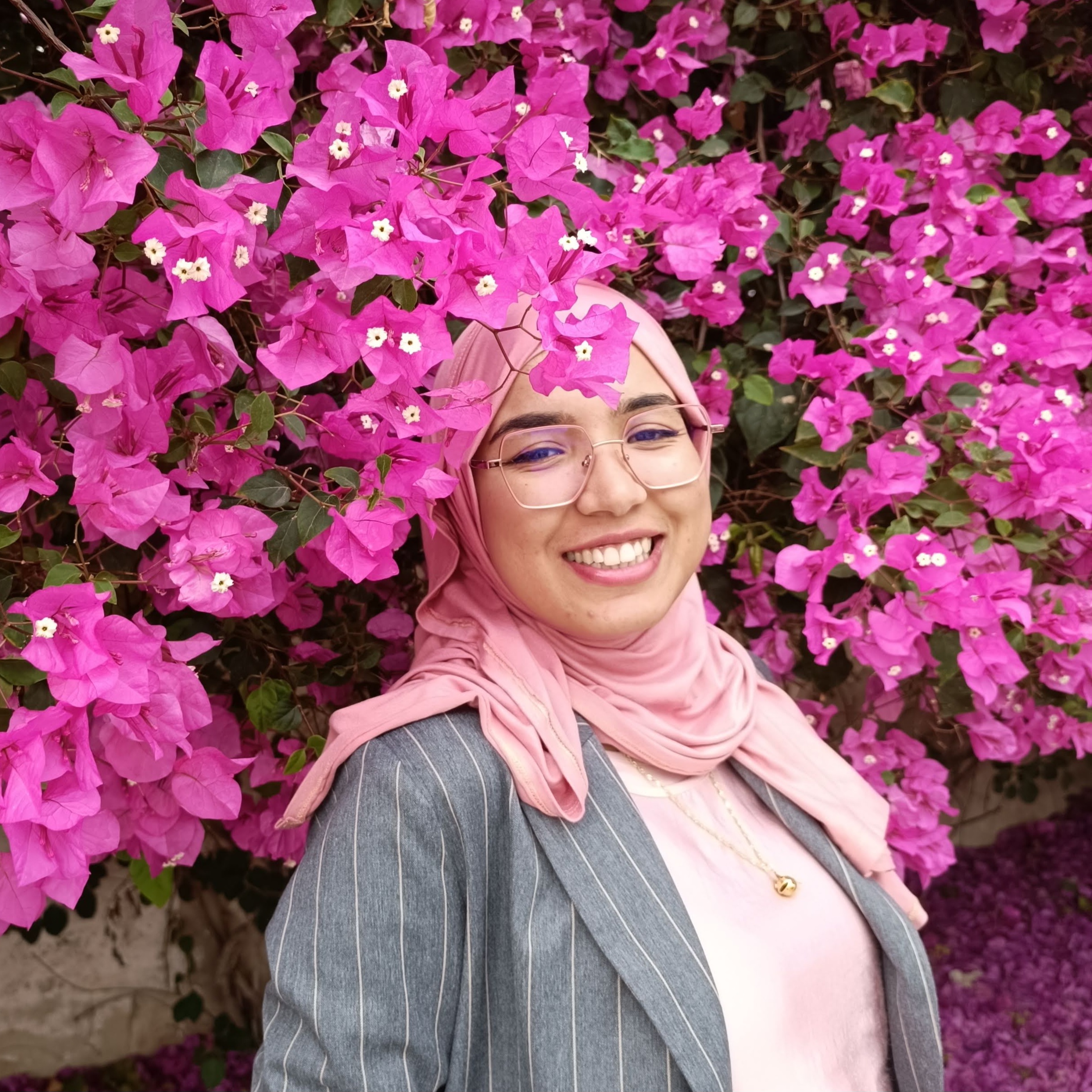
I was born in El Kef, in the northwest of Tunisia. My city has been known as the “City of Love and Beauty” since Roman times. It is a culturally rich place where art feels naturally present in everyday life: in the streets, in the shape of the country, in the way people speak, and in how different people live together. To me, it feels like art, like a special world. Growing up in such an environment deeply shaped the way I perceive the world as a big garden. A garden needs many different types of flowers to be truly beautiful, just like the world needs different people, cultures, and perspectives. With respect, love, and care for one another, this garden becomes even more beautiful.
A garden needs many different types of flowers to be truly beautiful, just like the world needs different people, cultures, and perspectives.
Mathematics has always been at the center of my life. From an early age, I enjoyed working with numbers and solving problems mentally, and I often saw the world as a collection of problems, each with its own strategies and solutions. I chose mathematics as my academic track during high school, and after obtaining my baccalaureate, I continued to pursue mathematics, as I have always been passionate about it.
I consider mathematicians to be artists in their own way: they express creativity through research, abstraction, teaching, and problem-solving.
If I had to describe what makes me happy, I would say: mathematics and flowers, and even more, the idea of bringing both together. For me, there is a deep connection between mathematics and art. Flowers represent natural beauty, harmony, and simplicity, while mathematics provides the tools to understand, describe, and structure that beauty. Mathematics transforms complexity into clarity, while art expresses meaning beyond words. I consider mathematicians to be artists in their own way: they express creativity through research, abstraction, teaching, and problem-solving. In this sense, mathematics is not only a scientific discipline but also a form of artistic expression.
A meaningful milestone in my journey was participating in the Heidelberg Laureate Forum 2025, an annual international gathering where 200 outstanding young researchers in mathematics and computer science spend a week engaging with the world’s most prestigious laureates. Blending scientific dialogue with meaningful networking, the Forum creates a unique space for inspiration, mentorship, and the exchange of ideas, shaping the next generation of innovators. During this experience, I had the opportunity to present my artwork: “تونس من حدودها نعيد رسم الأعماق” (“Tunisia From Its Boundary We Redraw Its Interior”).
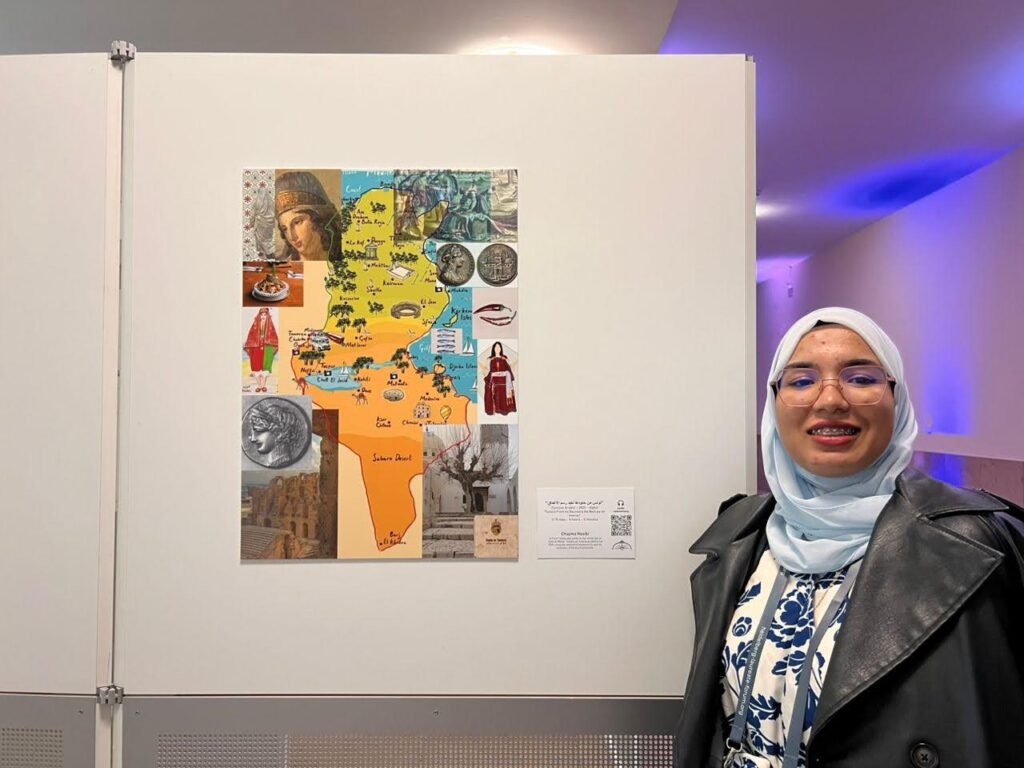
This artwork reimagines Tunisia as a Calderón inverse problem, a problem where one attempts to reconstruct the internal structure of an object using only information measured at its boundary. In my artwork, it means reconstructing a nation’s soul using only its borders. Tunisia is not just land enclosed by lines, it is emotion, culture and history expressed along every edge. Inspired by Queen Dido’s legendary optimization problem, the artwork reflects the power of geometry, identity, and feminine genius.Tunisia is a country of art and culture; its borders are the key to understanding its identity. In this regard,Tunisia can be seen as a perfect inverse problem. To understand Tunisia, we must study its borders mathematically and with our heart. This experience allowed me to merge my mathematical mindset with artistic expression, and to share a personal vision that connects identity, culture, and creativity.
I’ve always wanted to understand my father’s brain injury and for this reason now I am interested in biomathematics.
A defining moment in my life came when my father had a serious accident at a young age, which caused him to lose his memory. He no longer recognized me as his daughter. This deeply affected me and led me to question the functioning of the human brain and memory. This personal experience motivated me to pursue science with determination and to better understand complex systems. I’ve always wanted to understand my father’s brain injury and for this reason now I am interested in biomathematics.
During my PhD at LAMSIN (Laboratory of Mathematical and Numerical Modeling in Engineering Sciences), I worked in the field of inverse problems, which focuses on recovering unknown information from observed data, exploring both its theoretical and applied aspects. I did not fully answer the questions that motivated me, since understanding a system as complex as the human brain is a huge challenge, but the journey gave me strong analytical and research skills.
As a PhD student, I also had the opportunity to complete an internship at BCAM (Basque Center for Applied Mathematics), where I worked on real-world problems in an international research environment. This experience was particularly valuable, as it allowed me to apply mathematical tools to practical situations and collaborate with researchers from different backgrounds. Conferences, summer schools, and workshops, where I exchanged ideas with other researchers, strengthened my interest in research and confirmed my desire to pursue an academic career that combines both teaching and research. Teaching at National Engineering School of Tunis (ENIT) during my PhD has been one of the most fulfilling aspects of my journey: I enjoy explaining concepts and helping others understand mathematics, and sharing knowledge gives me a sense of purpose.
Mathematics has taught me how to think logically, analyze complex situations, and break down difficult problems into simpler components. It is a powerful tool for understanding real-world phenomena (…).
Today I am a postdoctoral researcher, continuing to develop my research skills, and working on advanced mathematical problems. My work today is strongly connected to the foundations I built during my studies. Mathematics has taught me how to think logically, analyze complex situations, and break down difficult problems into simpler components. It is a powerful tool for understanding real-world phenomena and contributing to fields such as healthcare, economics, and engineering.
I am particularly interested in biomathematics, where mathematics is used to study biological systems. I aim to contribute to research that helps better understand complex systems such as the human brain and diseases.
As a woman in STEM and as a woman from Africa, I believe that talent exists everywhere, but opportunities are not always equally distributed.
As a woman in STEM and as a woman from Africa, I believe that talent exists everywhere, but opportunities are not always equally distributed. Women often have to work harder to be recognized, and representation in many scientific fields is still limited. My journey reflects both personal determination and the broader context of striving for excellence in environments where opportunities are sometimes limited. This identity has strengthened my resilience, ambition, and sense of purpose.
I believe that achieving gender equality in STEM starts with changing mindsets and ensuring equal opportunities. Encouraging girls to pursue STEM is important, but it is equally essential that society as a whole supports and values women’s contributions in science. I also believe that a fulfilling professional life can coexist with a meaningful personal life. In the future, I hope to build both a career and a family. While balancing these responsibilities can be challenging, I believe it is possible with determination, organization, and support.
For me, mathematics remains more than a discipline, it is a way of thinking, a source of inspiration, and a path toward understanding the world while appreciating its beauty, much like flowers.
Recent Comments